

Understanding the E‑2 Visa in 2026
The E-2 Treaty Investor Visa has always rewarded preparation, but in 2025 and 2026 the bar has moved. Consular officers and USCIS adjudicators are scrutinising applications more closely than in previous years, and the business plan has shifted from a supporting document to the centrepiece of the entire petition.
Unlike many U.S. visa categories, there is no annual cap on E-2 visas, and status can be renewed indefinitely, which makes the strength of the business plan critical not just at filing, but at every visa renewal that follows.
If you are exploring the E-2 for the first time, this guide covers everything you need to know, from eligibility and E-2 visa requirements to what USCIS actually expects from a business plan in 2026. If you have been through the process before, the standards have changed, and this article explains exactly how.
What Is the E‑2 Treaty Investor Visa?
The E‑2 is a non-immigrant visa that allows nationals of treaty countries to enter and work in the U.S., provided they make a substantial investment in a bona fide enterprise. The E-2 is a temporary visa, typically granted in two-year increments, with no statutory cap on renewals. This allows investors to maintain E‑2 status indefinitely, as long as the business remains in operation and meets the programme requirements. This ongoing requirement is why the business plan is so important: it is the central document that proves the enterprise is viable, not only at the initial filing but at every renewal.
Eligibility & Treaty-Country Requirements
Applicants must be citizens of a country in a treaty of commerce and navigation with the U.S. to qualify. Currently, over 80 countries hold qualifying treaties, including the United Kingdom, Germany, Japan, South Korea, Australia, Canada, France, and Turkey (see the U.S. Department of State for a complete list).
Notably absent from the treaty list are China, India, Brazil, and Russia, whose nationals are among the largest sources of foreign entrepreneurs and investors. Dual nationals can apply through their treaty-country nationality, although consular officers will seek genuine ties, such as domicile or primary residency, to the treaty country. Nationals from non-treaty countries often pursue the EB-5 or L-1 as alternatives.
Substantial Investment & Non-Marginality Criteria
There is no fixed minimum investment amount defined in the regulations. Instead, USCIS applies a proportionality test, meaning the investment must be substantial relative to the total cost of starting or acquiring the business. In practice, many successful E-2 cases involve investments of around $100,000 or more, although lower amounts may qualify depending on the business model.
The investor must demonstrate that the funds are irrevocably committed and genuinely at risk, meaning they are already invested and subject to partial or total loss if the business fails. Loans secured by the business’s own assets do not count toward the investment, since the investor is not personally exposed to risk.
USCIS also requires that the business not be marginal. This means it must have the potential to generate more than enough income to support the investor. This is typically demonstrated through job creation and financial projections.
Why a Detailed Business Plan Matters for E‑2 Visa Approval
USCIS Scrutiny and 2026 Updates
The scrutiny of E-2 Business Plans has intensified in 2025 and 2026. In practice, officers have cross-referenced business-plan claims against actual market data; renewals are treated with the same rigour as initial filings; and source-of-funds documentation includes tracing every dollar back to its origin. Whether scrutinizing salary, property sales, inheritance, or even gifts, officers are carefully flagging unexplained gaps in the paper trail. Consular interviews have also become more detailed and business-focused, with officers expecting internal consistency throughout the plan.
Common Reasons for Denials: How a Business Plan Mitigates Them
E‑2 denials are typically due to:
- insufficient investment that is not “at risk”;
- the business appearing marginal with no capacity for job creation;
- sources of funds cannot be traced;
- or a vague, contradictory, or unrealistic business plan.
A successful business plan is explicit about the origin and use of all funding; supports revenue projections with real market research; outlines a concrete hiring plan and timeline; and makes clear that the investor actively runs the business, rather than just contributing capital from a distance.
Hypothetical Example
The following is a hypothetical example for illustrative purposes only. It does not represent a real case or real individuals.
An investor plans to open a small consulting business in the U.S. with a $100,000 investment. In the initial business plan, they project high revenue and quick hiring, but do not clearly explain how they will find clients or support these numbers with market data.
In a revised version, the investor lowers the projections, adds a clear client acquisition plan, and adjusts the hiring timeline to be more realistic. This makes the business plan more credible and aligned with what officers expect: realistic assumptions and a clear execution plan.
Key Elements USCIS Looks For in a 2026 E‑2 Business Plan
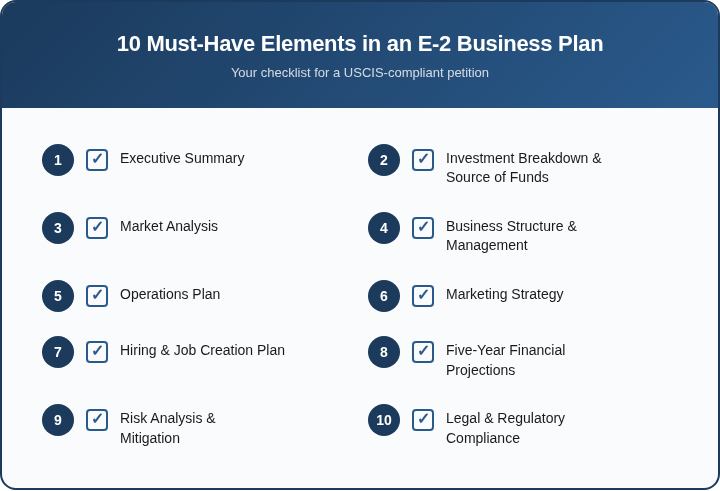
Below is a walk-through of each component that officers currently expect from an E‑2 business plan:
Executive Summary Aligned with 2026 Standards
The executive summary is the first section an officer reads; it will determine whether the rest of the plan is carefully scrutinized or cursorily skimmed. The executive summary should state the business concept in plain language, identify the legal entity and its location, disclose the total investment amount and ownership percentage, and summarize projected job creation for years 1 to 5.
Hint: If an officer cannot clearly understand what the business does, the investment amount, and the job creation plan within the first paragraph, the summary needs to be rewritten.
Detailed Investment Breakdown & Source of Funds
Officers want to see where every dollar is going, so break the investment into categories and provide supporting documentation, like purchase receipts, signed leases, vendor contracts, and bank statements, like so:
Table: Investment Breakdown Example ($100,000 Startup)
| Category | Amount (USD) | % of Total |
| Equipment & Fixtures | $25,000 | 25% |
| Lease Deposit & Build-Out | $18,000 | 18% |
| Initial Inventory / Supplies | $12,000 | 12% |
| Working Capital (6 months) | $20,000 | 20% |
| Marketing & Branding Launch | $8,000 | 8% |
| Technology & Software | $7,000 | 7% |
| Legal, Licensing & Permits | $6,000 | 6% |
| Insurance & Miscellaneous | $4,000 | 4% |
| TOTAL | $100,000 | 100% |
Equally important is proving the lawful source of funds by tracing the money from its origin (personal savings, property sale, income, gifts) through bank records to the point of commitment.
Hint: Gift funds from foreign relatives are not disqualifying but do trigger enhanced scrutiny; ensure the paper trail is airtight.
Market Analysis & Competitive Positioning
Officers expect localised analysis; no longer accepting generic national-level industry overviews. The plan should address the size of the market in the specific city or metro area, consumer trends supporting demand, and a realistic look at the competitive landscape, including the main competitors, their pricing, and where the business fits in.
Hint: Use current, localised data. If you do not have access to paid industry reports, rely on publicly available sources such as the U.S. Census Bureau or other local data sources.
Business Structure & Management Roles
Officers in 2026 are increasingly sceptical of arrangements where investors appear to take a passive role. Franchise investors, for instance, must show genuine, hands-on involvement in management. The ownership structure and the investor’s genuine managerial role should be explicit: they must hold at least 50% of the enterprise or demonstrate equivalent operational control.
Hint: Include an organisational chart with management roles, staffing timelines, and a description of each team member’s qualifications. If the investor serves as CEO or managing director, describe their day-to-day duties.
Operations & Development Plan
Be clear when describing how the business actually runs day-to-day: its operating hours, supplier and vendor relationships, production/service delivery workflows, sales approach, and the technology required. Include the address and layout of physical locations; for consulting, home services, and client-facing businesses, describe how scheduling, dispatch, and quality control work.
Hint: If you cannot describe how the business operates on a typical day, including who does what and how services are delivered, the plan is not detailed enough.
Marketing & Growth Strategy
Officers want to see a realistic plan for customer acquisition, not a general intention to market the business. Include all estimated marketing spend and customer acquisition costs, where possible.
Hint: Include realistic customer acquisition assumptions. Statements like “we will use social media” are not enough without explaining how clients will actually be acquired.
Hiring & Job Creation Plan
Job creation capacity is one of the clearest indicators that a business is not “marginal”; it exists beyond merely earning just enough for investors and their families. A plan that projects the creation of at least three to five full-time positions within the first five years is generally viewed favourably, although there is no specific quota.
Hint: Specify the roles, expected wages, and hiring timeline for the new jobs: e.g. one full-time employee at launch, a second by month six, and a third by the end of year two. Ensure these projections are achievable: upon E-2 renewal, officers will compare projections from the initial filing with actual payroll records, W‑2 filings, and tax returns to confirm job creation was successful. Job creation must be achievable rather than aspirational.
Five-Year Financial Projections
Projections must demonstrate that the business will surpass “marginality”; i.e. it will contribute meaningfully to the economy through employment and revenue.
Year one should be broken out monthly; year two, quarterly; and years three through five, annually. Each period should include a profit-and-loss statement, a cash-flow statement, and a balance sheet. State assumptions clearly, like revenue growth rates, operating margins, and seasonal fluctuations, and tie them to the market analysis to justify the numbers.
Hint: Well-supported numbers on the conservative end are far more persuasive than inflated forecasts. Actual projections must reflect the investor’s specific industry, location, and market conditions.
Risk Analysis & Mitigation
Officers do not expect a risk-free venture; an investor who has thought through risks and has a realistic plan of response is favorable. A strong plan identifies the main operational, market, financial, and technology risks and explains how each will be managed and mitigated. What are the backup suppliers if the main fails? How will the cost structure adjust in a recession?
Hint: Every business carries risk, and pretending otherwise undermines credibility. Identify risks and provide realistic contingencies.
Legal & Regulatory Compliance
Officers assess compliance to determine whether the investor has performed due diligence to genuinely operate the business in the U.S. in good faith. The investor can also reaffirm their plans to actively and genuinely direct and develop the enterprise, as required by the statute.
Hint: Cover all licensing and permit requirements, industry-specific regulations (health codes, professional certifications), and confirm that funds come from lawful sources.
Best Practices & Common Mistakes for 2026 E‑2 Business Plan
Align Projections with Market Realities
As mentioned, overly optimistic revenue forecasts readily trigger scepticism. If comparable businesses in the same market region typically earn $200,000 in their first year, projecting $500,000 without a compelling explanation will invariably raise red flags. Be explicit and evidence-based: rely on industry benchmarks, local competitor data, and conservative assumptions. In 2026, officers will be checking.
Document Active Investment & Lawful Funds
The investment must be genuinely “at risk,” meaning that funds have been committed to the business before the petition is filed. Funds sitting in a bank account earmarked for future use are insufficient. Every dollar should be traceable from its lawful origin to its current deployment in the business, whether through signed leases, equipment purchases, vendor contracts, payroll, or elsewhere.
Demonstrate Non-Marginality & Job Creation
To be “non-marginal”, the business must produce income well beyond what the investor and their family need to live. A plan showing the investor drawing $60,000 while the business generates $65,000 in net profit leaves little room for economic impact. Strong plans show net income at least double the family’s living expenses, or a clear job-creation trajectory over five years.
Connect the Plan to the Investor’s Experience & Industry
Officers also look for a logical connection between the investor’s profile and professional background and the business. A software engineer opening an IT consultancy is a natural fit; the same person opening a restaurant with no food-service experience may face increased scrutiny. Address the connection directly by explaining any relevant training, partnerships, or advisory relationships that bridge the gap between the investor’s profile and their proposed business.
Plan for Renewals & Long-Term Sustainability
Since E‑2 status must be renewed every two years, the business plan should demonstrate how the business will grow, how new positions will be created, and how the non-marginality requirement will be maintained. In 2026, renewals are scrutinised almost as closely as initial applications, with officers comparing earlier projections against actual performance.
Industry Trends for E-2 Investors in 2026
Service-Based & Recession-Resilient Sectors
E‑2 investors are gravitating toward business models that offer scalability, recurring revenue, and resilience. Investors are gravitating toward a handful of sectors:
- professional services (consulting, accounting, digital marketing),
- technology and digital services (SaaS platforms,
- IT support, app development),
- logistics and transportation (last-mile delivery, freight brokerage),
- healthcare support (home health aides, medical staffing),
- and speciality trades (plumbing, electrical, and HVAC).
Franchise models, particularly in-home services, insurance, and healthcare, are popular with E-2 investors due to the established operating procedures, training programmes, and financial track records, which make it easier to build realistic projections and demonstrate business viability. Demand for these services also typically holds steady regardless of economic conditions.
Geographic and Sector-Specific Considerations
It is important that not every state or metro area will present the same market opportunities. A tech consultancy in Austin, Texas, faces a different competitive landscape than in rural Ohio; business plans should reflect these distinctions, including local wages, state licensing requirements, demand trends, and cost-of-living distinctions. These must all be reflected in financial projections to establish overall business plausibility. Certain sectors have state-specific regulatory requirements: state-level licensure for healthcare businesses, local health department codes for food-service operations, and contractor licensing for trades businesses. Addressing these details explicitly demonstrates that investors have undergone genuine due diligence.
Conclusion & Additional Resources
A strong E‑2 business plan involves multiple elements that reflect a detailed, consistent story:
- a substantial, at-risk investment;
- a viable, non-marginal enterprise;
- and an investor who will actively direct and develop the business.
Officers look for a credible plan that reflects this story and reject those that appear to be merely checking boxes. From the executive summary to the risk analysis, every section must be grounded in actual data, honest and defensible projections, and thorough and internally consistent documentation. It is strategically advantageous to treat the business plan as a living document, updating it on an ongoing basis; it must be detailed enough to withstand scrutiny during initial filings and later renewals. Working with professionals experienced in U.S. immigration law is not required for filing, but can make a real difference.
Investors should expect the full process (from entity formation and investment to plan drafting and filing) to take around 3-6 months. Consular applicants must complete Form DS-160 and attend an embassy interview. For investors already in the U.S., they are required to file Form I-129, with standard processing taking 2 to 4 months, or premium processing (filed with Form I-907), which shortens the wait time to 15 business days.
If you are preparing an E-2 business plan, getting the structure right from the beginning can make a significant difference in how your visa application is evaluated.
FAQ
Do I need to create jobs for U.S. workers?
There is no strict requirement to hire U.S. workers, but demonstrating either job creation or meaningful revenue well beyond the investor’s living expenses is essential to satisfy the non-marginality requirement. There is no quota for job creation, but most successful plans project three to five full-time positions within five years. Jobs do not need to be filled at the time of filing, and a credible, timeline-based hiring plan is sufficient at the initial stage.What common mistakes lead to E‑2 visa denials?
The most frequent causes are insufficient investment that cannot be shown to be genuinely at risk, funds that cannot be traced to a lawful source, a business plan that is vague, contradictory, or relies on unsupported projections, an investor who appears passive rather than managerial, and failure to demonstrate that the business can grow beyond supporting just the investor’s household.How do I maintain E‑2 status beyond the initial approval?
Plan ahead from day one. Maintain thorough business records, payroll documentation, and tax filings. At renewal, officers will compare your original projections against actual performance including revenue, hiring, and investment deployment. The renewal filing window opens 90 to 180 days before expiration. Treat the business plan as a living document and update it before each renewal to reflect actual results and the next phase of growth.How important is working with an attorney or professional business plan writer?
Neither is legally required, but both can make a meaningful difference. An immigration attorney ensures the petition is structurally sound and anticipates adjudicator concerns. A professional business plan writer ensures internal consistency, realistic projections, and market data that holds up under scrutiny. Given the increasing denial rates in 2025 and 2026, many investors find the cost worthwhile, particularly for higher-investment cases or industries that face additional regulatory complexity.
Need help with your case? Schedule a call with our customer care team. They’ll be happy to discuss your needs and connect you with an immigration attorney.