
Not having a green card does not automatically disqualify you from opening a U.S. bank account. Most banks and credit unions are legally permitted to open accounts for non-citizens, including O-1A visa holders, and many do so regularly. What you need is the right combination of documents, and, in some cases, a bit of persistence if the first institution you try says no.
Quick answer: can you open a U.S. bank account without a green card?
Yes, in most cases. U.S. law does not require a green card or Social Security number (SSN) to open a basic checking account. Banks are required by federal law to verify your identity, but they have flexibility in how they do that. Many institutions accept foreign passports, Individual Taxpayer Identification Numbers (ITINs), and other government-issued IDs as valid alternatives.
That said, policies differ significantly from one institution to the next. Depending on the bank, some institutions have more experience working with newly arrived visa holders, while others may be unfamiliar with the process and decline without a clear reason. If one bank says no, that is not the end of the road.
In practice, some larger national banks, such as Chase and Bank of America, as well as many credit unions, are familiar with opening accounts for newly arrived visa holders. Requirements still vary by institution and branch, but if one bank cannot help, it is often worth trying another before assuming you are not eligible to open an account.
What US banks usually need to verify your identity
Federal law requires banks and credit unions to verify your name, date of birth, address, and an identification number before opening an account. Beyond that minimum, each institution sets its own requirements.
Passport or government-issued ID
Most banks require at least one photo ID issued by a government. A valid foreign passport is widely accepted. Some institutions also accept consular identification cards, for example, the Matricula Consular issued by the Mexican consulate, and similar cards issued by consulates of other countries in the United States. If you do not have a U.S. or state-issued ID, check with the specific institution about which foreign IDs they accept, as policies vary.
U.S. address or proof of residence
You will need to provide a U.S. address. If your ID shows a different address than where you currently live, many banks will ask for proof of address, such as a recent utility bill, lease agreement, or a letter from your employer. If you recently arrived in the U.S. and do not yet have a stable address, applying in person is often easier than applying online, since online systems frequently rely on electronic address verification.
SSN, ITIN, or alternative identification number
An identification number is required, but it does not have to be a Social Security Number (SSN). According to the Consumer Financial Protection Bureau (CFPB), acceptable identification numbers include a Social Security Number, an Individual Taxpayer Identification Number (ITIN), a passport number and country of issuance, an alien identification card number, or another government-issued identification number. Depending on the bank, these and other forms of identification may be accepted as part of the account opening process.
If you have neither an SSN nor an ITIN, some banks will still open a basic, no-interest checking account using your passport number and visa documentation. However, to open an interest-bearing account, you generally need either an SSN or an ITIN, since interest income is subject to federal tax reporting.
Immigration documents and visa status evidence
While banks are not immigration agencies and do not make decisions based on visa type, bringing your visa and immigration documents helps confirm your legal presence in the U.S. and can speed up the verification process. Useful documents include your valid visa stamp, Form I-94 (arrival/departure record), and, where applicable, your Employment Authorization Document (EAD) or visa approval notice.
Step-by-step: how to open a bank account in the U.S. for the first time
Step 1: Prepare your identification documents
Before you go to a branch or start an online application, gather everything you may need. Having more documentation than the minimum required reduces friction and gives the bank representative less reason to pause. The FDIC recommends gathering documents to verify your identity before starting any application in person or online. For newly arrived visa holders, that preparation matters more than it would for a U.S. citizen.
Step 2: Decide whether to apply online or in person
Online applications are convenient but have limitations for new arrivals. If you recently moved to the U.S., the bank’s identity verification system may not yet be able to match your address electronically, and some online platforms require an SSN. In these cases, a branch visit often works better. In person, you can present your documents directly, ask questions, and speak with a representative who can escalate the application if needed.
Step 3: Ask about SSN/ITIN alternatives
If you do not yet have an SSN, which is common for O-1A holders who just arrived, ask the bank directly whether they accept a passport number or ITIN as an alternative. Do not assume the answer is no. Many institutions accept alternatives but do not advertise this clearly.
Step 4: Start with a checking account and debit card
Start with a basic checking account. It is the most accessible product, requires no credit history, and gives you immediate access to a debit card. Savings accounts and interest-bearing accounts may require an SSN or ITIN for tax-reporting purposes, so it makes sense to handle those after you are more settled.
When comparing accounts, consider:
- Whether the account is FDIC-insured (funds in FDIC-insured accounts are protected by the U.S. government up to $250,000);
- Whether there is a monthly fee or a way to waive it;
- Whether the bank charges overdraft fees – some accounts decline transactions when funds are insufficient instead of allowing overdrafts;
Step 5: Build credit after banking is set up
Once you have a checking account and a debit card, you can begin working toward a U.S. credit history. This is a separate process and typically involves applying for a secured credit card or becoming an authorized user on an existing account. Banking is the first step; credit building comes after.
What to do if you do not have an SSN yet
An SSN is issued to people authorized to work in the U.S. O-1A visa holders are typically eligible for an SSN, but they may not have one yet when they first arrive. If your SSN application is pending:
- Bring your visa approval notice, Form I-94, and passport to the branch;
- Explain that your SSN is pending and ask whether the bank can open an account in the interim;
- Some institutions will open an account without an SSN and update the record once one is issued;
- If a bank declines, ask specifically whether they have a process for newly arrived visa holders, not all frontline staff are equally familiar with these situations;
When an ITIN may help
An ITIN, Individual Taxpayer Identification Number, is a nine-digit number the IRS issues to individuals who need a U.S. taxpayer identification number for federal tax purposes but are not eligible for an SSN. Resident aliens, nonresident aliens, and their spouses and dependents may apply for one regardless of immigration status.
For banking purposes, an ITIN can be useful in two ways. First, some banks that require a tax identification number will accept an ITIN in place of an SSN for identity verification. Second, an ITIN is required to open an interest-bearing account, since the bank must report interest income to the IRS.
In most cases, applying for an ITIN requires submitting Form W-7 (Application for IRS Individual Taxpayer Identification Number) together with a U.S. federal income tax return and supporting documents proving foreign status and identity. Certain exceptions apply, so review the current IRS requirements before filing. Applications can be submitted by mail to the IRS Austin Service Center or in person through an IRS Taxpayer Assistance Center, a Volunteer Income Tax Assistance (VITA) site, or a Certifying Acceptance Agent. Processing typically takes seven weeks, or nine to eleven weeks during tax season (January 15 to April 30).
Common problems and how to handle them
The bank says they cannot open an account without an SSN. Ask specifically whether they accept an ITIN or a passport number and country of issuance. If the answer is still no, try a different institution, policies vary widely.
The online application fails at the address or identity verification step. This is common for people who recently moved to the U.S. and have no credit or address history here. Visit a branch in person.
The bank says no without a clear explanation. Ask for an adverse action notice. Under the federal Fair Credit Reporting Act (FCRA), if a bank denies your application based on information from a checking account reporting company (such as Chex Systems or Early Warning Services), they must provide you with the name of that company. You can then request a free copy of your report and dispute any errors. Checking account reporting companies are generally required to exclude most negative information older than seven years.
You have never had a U.S. bank account and have no U.S. credit history. This is not the same as having a negative banking history. Many banks distinguish between applicants with no history and those with a negative one. Accounts designed to reduce overdraft risk may also be available and are often easier to open.
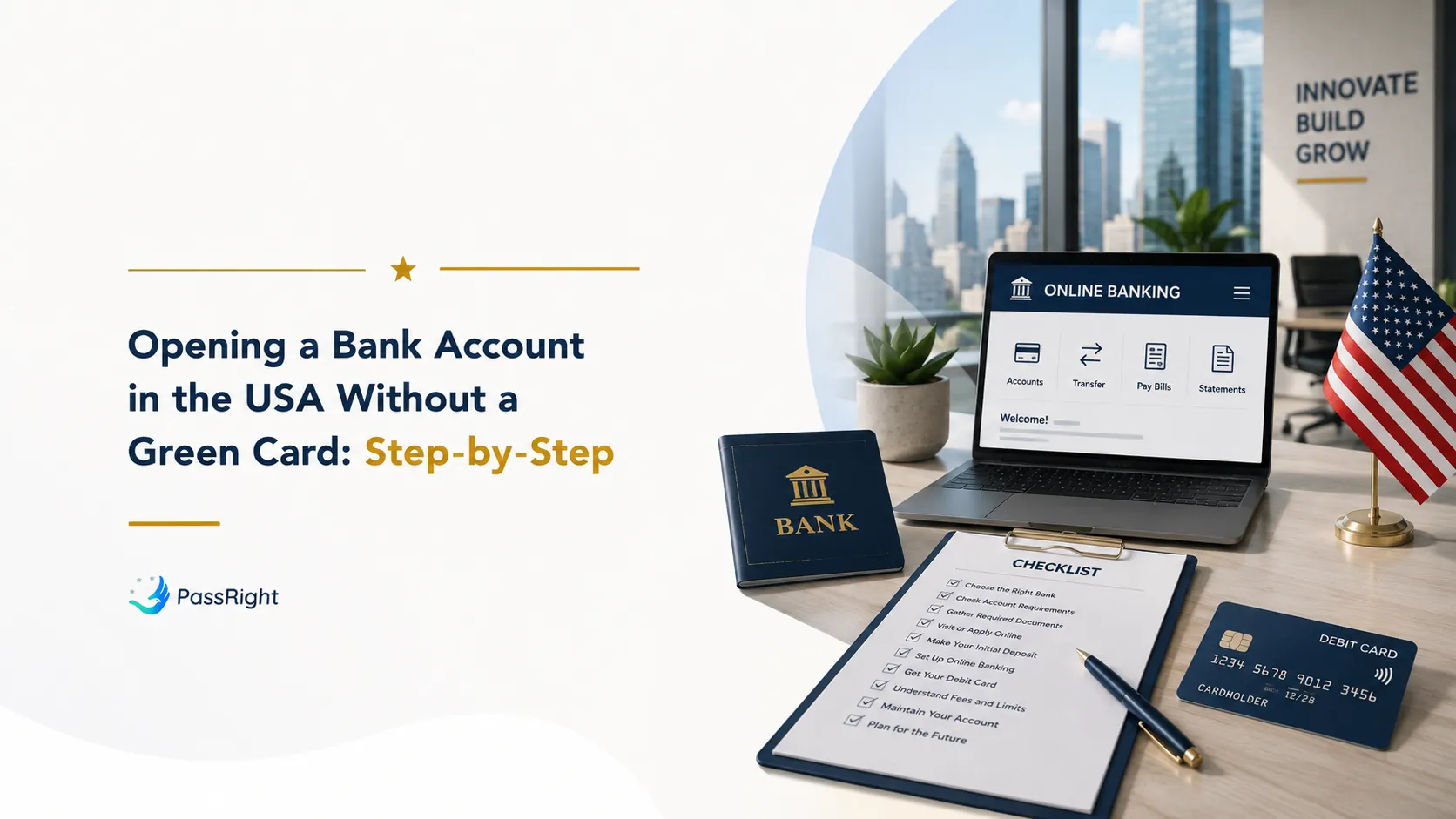
Bank account checklist for O-1A founders and professionals
Use this checklist before visiting a branch or starting an online application.
| Document | Why it matters | Possible alternative |
|---|---|---|
| Valid foreign passport | Primary photo ID accepted at most banks | U.S. driver’s license or state ID, if you have one |
| U.S. visa stamp or visa approval notice | Confirms legal presence in the U.S. | Form I-94 printout |
| Form I-94 arrival/departure record | Additional immigration evidence | Visa approval notice, Form I-797 |
| Proof of U.S. address | Required to verify current address | Lease agreement, utility bill, or employer letter |
| SSN or ITIN | Identification number for account setup | Passport number and country of issuance, depending on the bank |
| Initial deposit | Required to open most accounts; typically $25–$100 | Debit card, prepaid card, or electronic transfer |
Questions to ask the bank before opening an account:
- Do you accept a foreign passport as primary ID?
- Do you accept an ITIN or passport number instead of an SSN?
- Is the account FDIC-insured?
- What are the monthly fees, and how can they be waived?
- Does the account charge overdraft fees?
- What is the minimum balance required to avoid fees?
Frequently asked questions
Can I open a U.S. bank account without a green card?
Yes. A green card is not required. Banks must verify your identity, but they have flexibility in which documents they accept. A valid foreign passport combined with proof of a U.S. address and an identification number (SSN, ITIN, or passport number) is sufficient at many institutions.Do I need an SSN to open a bank account in the U.S.?
No, though it helps. Many banks accept an ITIN or a passport number in place of an SSN for basic checking accounts. You generally do need an SSN or ITIN to open an interest-bearing account, since interest income must be reported to the IRS.Can I open a U.S. bank account online as a new immigrant?
Possibly, but in-person applications tend to work better for new arrivals. Online systems often require electronic address verification, which can fail if you have no prior U.S. address or credit history. If an online application is rejected, visiting a branch is usually the next step.What if a bank refuses to open an account for me?
Ask for an adverse action notice with the name of any checking account reporting company they used. Request a free copy of that report and check for errors. Then try a different institution, each bank sets its own policies, and a refusal at one does not mean a refusal everywhere.
Sources consulted
Consumer Financial Protection Bureau (CFPB):Checklist for Opening a Bank or Credit Union Account
CFPB: Why Was I Denied a Checking Account?
FDIC: How to Open a Checking or Savings Account
FDIC: How to Pick a Bank Account
IRS: Individual Taxpayer Identification Number (ITIN)
IRS: How to Apply for an ITIN
Need help with your case? Schedule a call with our customer care team. They’ll be happy to discuss your needs and connect you with an immigration attorney.