

Understanding the O‑1 Visa RFE Landscape in 2026
This guide is for you if you are preparing an O-1 petition and want to avoid an RFE (Request for Evidence) from the start, or if you have already received an RFE and need to understand how to respond effectively.
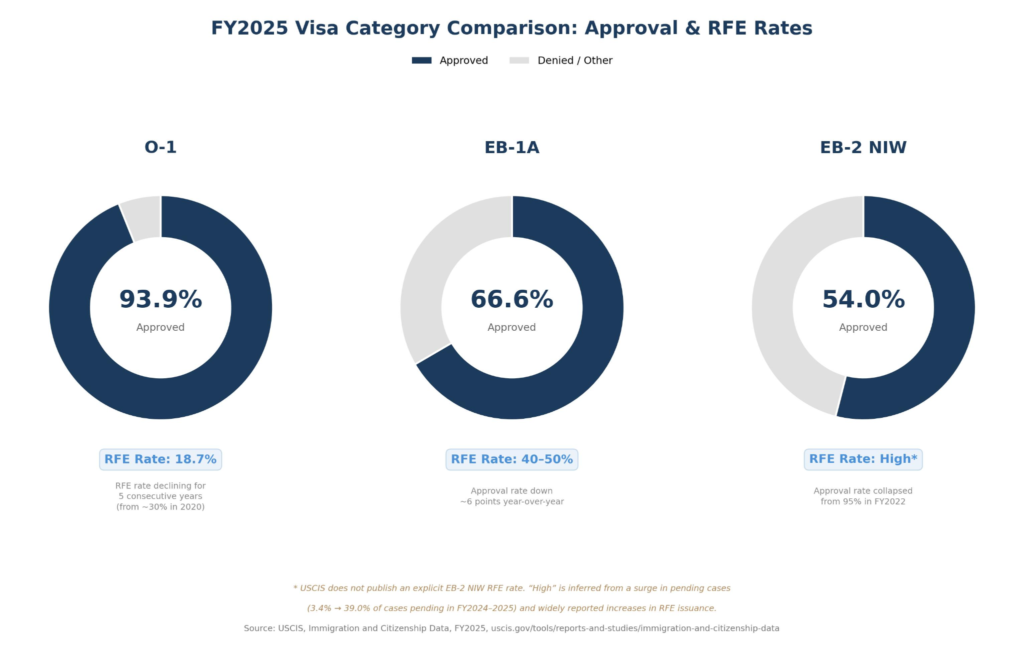
According to USCIS data, O-1 RFE rates dropped to 18.7% in FY2025, the lowest in five years, while approval rates remained above 93%. Despite this, RFEs remain common for tech founders, often triggered by misaligned evidence, vague itineraries, or weak expert letters. This guide covers the most common O-1 RFE triggers, how to avoid them before filing, and how to respond effectively if you receive one.
If you receive an RFE, the first step is simple: do not panic. An RFE is not a denial, but an opportunity to strengthen your case by directly addressing the officer’s concerns with additional evidence.
USCIS is currently processing record volumes of employment-based petitions, which has led to a higher number of RFEs across all visa categories. Founders who understand what triggers RFEs and how to address them still maintain strong approval rates.
What’s Driving O-1 RFEs in 2026
Even though O-1 RFE rates have decreased overall, the level of scrutiny has increased. This shift is driven by three main factors.
First, USCIS now uses automation tools that flag incomplete petitions before they reach a human officer. At the same time, the January 2025 policy updates introduced clearer standards for qualifying evidence under each criterion.
Second, adjudicators are applying these standards more consistently, which leaves less room for loosely connected or weakly explained evidence.
Third, the surge in O-1 filings from startup founders has introduced new types of evidence, such as open-source contributions, AI benchmarks, and product adoption metrics. These do not always fit traditional adjudication frameworks, which can lead to additional scrutiny.
Common Triggers for O‑1 RFEs
Immigration practitioners have noted recurring issues that trigger O-1 RFEs. Anticipating and avoiding these triggers in the initial filing can mean the difference between a quick resolution and months of exchanges. These common triggers follow:
Missing or Incomplete Documentation
The most common reason for an RFE is missing documents. A complete advisory opinion from a relevant peer group, a signed employer or agent contract, and a detailed employment itinerary are necessary: leave any of these out and an RFE can be readily expected. For tech founders, the advisory opinion is a frequent point of contention: for startups related to machine learning and fintech, founder-beneficiaries will need an advisory opinion from an expert or body qualified to evaluate accomplishments and expertise in that particular intersection, not a boilerplate opinion from an unrelated group.
Misalignment Between Evidence and Criteria
Another common mistake is submitting evidence without explicitly connecting it to the criterion. For example, a press article about a company’s funding round might seem like strong evidence for the “published material” criterion, but if the article barely mentions the founder by name and focuses on praising the company, USCIS will not consider the evidence as published material about the petitioner, as the criterion requires. The fix is straightforward: add a brief note to accompany each document, expressing explicitly which criterion it supports and why.
Vague Itinerary or Agent Issues
USCIS requires a detailed plan, either month‑by‑month or project‑by‑project, of beneficiaries’ work in the United States. If filing through an agent, the petition also requires the agent’s role and relationship to be explicitly addressed for each engagement. Vague statements like “the beneficiary will continue to develop AI products” are insufficient. Adjudicators want specifics: what will be built, for whom, and by when.
Press & Awards: Independence and Selectivity
Press coverage lacking in editorial standards or that is affiliated with the beneficiary is an RFE trigger. Self‑published work, company releases, and paid placements do not meet USCIS requirements. Awards are subject to similar scrutiny: a “Top 30 Under 30” list from a publication with a transparent selection process carries weight, while an award from an accelerator that a beneficiary has paid to be a part of does not. To avoid this, document the selection process, the size and membership of the applicant pool, and the reputation of the outlet or organization for all evidence of recognition.
Totality Failures and Specialized Work
Even when multiple criteria are individually satisfied, a petition can still trigger a “totality failure” at the final stage of review.
In practice, this means that even though each requirement seems to be met on its own, the overall case does not clearly demonstrate extraordinary ability.
This decision is particularly common in newer fields, like AI or semiconductor design, where the officer may not understand why the totality of the work is significant or impactful. The solution is to ensure that detailed, plain‑language explanations of the originality, influence, and overall significance of the beneficiary’s work accompany each piece of evidence to contextualize their work as ultimately innovative, field-advancing, and therefore extraordinary.
New Triggers for Tech Founders
Given the influx of petitions for tech founders, new RFE triggers are becoming more common compared to even a couple of years ago. Namely, self‑promotional media, like company blog posts or PR‑arranged podcasts; expert letters reading like generic endorsements rather than detailed, field-specific technical evaluations; and evidence devoid of measurable impact metrics like adoption numbers, revenue, and other benchmarks, leaving adjudicators with no objective grounds for assessment, are all being increasingly flagged as insufficient.
Common O‑1 RFE Triggers and Recommended Responses
| RFE Trigger | Recommended Evidence / Rebuttal |
| Missing advisory opinion | Obtain substantive advisory from a relevant peer group |
| Incomplete contract/agent docs | Signed contract with clear terms |
| Vague itinerary | Month‑by‑month plan with projects, clients, deliverables, and timelines |
| Misaligned evidence | A clearly organized Index of Exhibits, including a cover page per exhibit explaining which criterion it supports and why |
| Self‑promotional press | Replace with independent coverage; include circulation data and evidence of editorial independence |
| Non‑selective awards | Document selection process, applicant pool, and the reputation of issuing bodies |
| Totality failure | Include detailed, field-specific expert letters that contextualize the work and provide a strong narrative summary, explicitly linking achievements to impact |
| Shallow expert letters | Revised letters naming contributions, explaining novelty, and quantifying effect |
| No measurable metrics | Adoption stats, revenue, citations, benchmarks with independent corroboration |
Preparing Strong Evidence Before You File
Avoiding grounds for an RFE altogether is ideal. Anticipate RFE triggers and aim for an RFE-proof petition from the initial filing: USCIS may still find grounds for an RFE, but a well-structured petition preempted against the most common triggers will produce a strong starting position.
Aligning Evidence to USCIS Criteria
To qualify for an O‑1 visa, applicants must meet at least three of eight criteria. It is typically advantageous to aim for more than three criteria, in case any are disputed. If the connection between the evidence and the criterion is not obvious within a few seconds, it may be RFE-able.
Demonstrating National/International Significance
Note that local or student-level recognition will not qualify; USCIS expects impact at a national or international level. Tech founders should demonstrate that their product is used across multiple countries, research is cited by institutions across jurisdictions, or that their company has attracted investment from nationally or globally recognized funds. Everything should be framed in terms of demonstrable, measurable reach: how many users, how many countries, how much revenue, how many citations; dropping big names is always beneficial.
Crafting Expert Letters
Expert recommendation letters are among the most influential pieces of evidence in an O‑1; therefore, they are the most frequently criticized. A good letter clearly describes the specific contribution, explains why it matters as a novelty in the field, quantifies impact with objective metrics, and leverages their understanding of the field or industry to effectively contextualize the significance of the work. The expert should have verifiable, relevant credentials that are explicitly mentioned to demonstrate that they are qualified to assess the beneficiary’s work: e.g., a professor who has published in the field, a CTO at a company using a founder’s technology, or a recognized authority in the domain. Letters by friends, co‑founders, or anyone appearing partisan will not suffice.
Quantifying Impact & Metrics
Qualitative claims are easy to contest; hard data is not. Provide objective evidence and favor numbers wherever possible: e.g., product users, revenue generated, performance gains, the downloads or forks of an open‑source project. Be sure to contextualize these numbers, particularly in the case of subject-specific jargon: explain what it means for a library to have 15,000 GitHub stars, relative to comparable libraries. Third‑party corroboration through analyst reports and other independent benchmarks adds significant credibility.
Preparing Supplemental Materials
Beyond the core exhibits, providing strong supplemental materials reinforces the evidence and the narrative of the beneficiary’s overall extraordinary ability. Providing adoption statistics from independent analytics platforms, analyst reports mentioning the technology, proof of conference participation, patent filings with prosecution histories, and media‑kit data for press outlets cited can corroborate the narrative, while anticipating an adjudicator’s next question and avoiding grounds for an RFE.
Already received an RFE? Everything from this point is for you.
How to Respond to an O‑1 RFE
Despite one’s best efforts, one can still receive an RFE with their initial O-1 filing. Although receiving an RFE may seem doom-worthy, the numbers tell a different story: out of the 93% of O-1A petitions that were approved, the majority of them involved an RFE. The quality of the RFE response is, of course, necessary to avoid an outright denial.
Reading the Notice and Identifying Issues
The first step is to read the notice carefully, cover-to-cover. USCIS will specify clearly and explicitly which criteria or documents they are questioning. Sometimes the RFE notice focuses on a single gap; other times, it raises broader concerns. Read the notice carefully and identify every issue, even minor ones. The response should address each and every issue raised.
Response Timelines and Deadlines
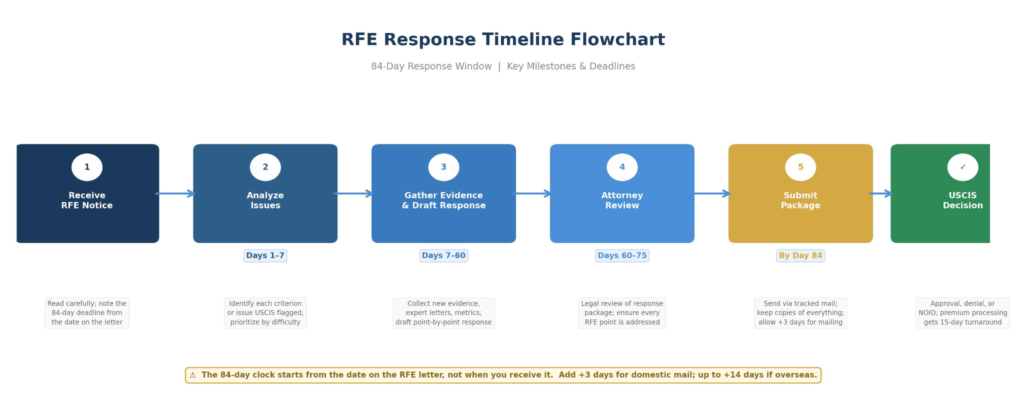
The beneficiary has 84 days (12 weeks) to provide a response, with mail delivery adding 3 extra days. Overseas applicants may receive a 14‑day extension that is not guaranteed. Be sure to check the deadline date on the notice. If the deadline is missed, the petition is simply denied or marked as abandoned, so calendar the due date immediately and plan next steps backward.
Organizing a Complete Response Package
Your response should include the original RFE notice, a cover letter outlining each issue, and all new or updated exhibits indexed. Tab and label every exhibit with a brief statement explaining precisely what it proves, addressing all concerns raised in RFE.
| Required Item | |
| ✓ | Copy of the original RFE notice |
| Cover letter addressing each issue raised | |
| Missing documents: advisory opinion, contracts, itinerary, etc. (as applicable) | |
| Revised or new expert letters, addressing RFE concerns | |
| Additional evidence exhibits, directly tied to the relevant criteria | |
| Narrative summary linking achievements to real-world impact | |
| Evidence index with one-line descriptions per exhibit | |
| Supporting metrics: adoption data, citations, revenue, benchmarks | |
| Independent press with circulation and editorial independence documentation |
Addressing Each Issue: Strategies & Examples
Follow a consistent structure when addressing each issue raised in the RFE, per criterion: directly quote the concern from the notice, contextualize it under the correct criterion, present new evidence, and explain why the standard is now met. Note concerns about missing documents and supply them immediately after, being clear and explicit about where new evidence fits in the overall petition. For any concerns regarding impact or significance, simply add context that more demonstrably reframes what has already been submitted: new metrics, stronger letters, public records, independent verification, etc.
Overcoming Totality Failures
A totality‑failure RFE may be the most challenging to rectify, since it requires more than presenting a noted, missing piece; it addresses the credibility of the “extraordinary ability” argument as a whole. The response must therefore be argument- or narrative‑driven. A good lawyer or legal specialist can assist with constructing this arc, moving beyond demonstrating “what” the evidence shows of the beneficiary’s accomplishments toward proving the “so what”: why the accomplishments matter and why they ultimately demonstrate extraordinary ability. One additional standalone approach that works is to include a narrative summary separate from the cover letter, describing the beneficiary’s career arc and how each accomplishment builds on the last. Supporting this with detailed expert recommendation letters will help strengthen the totality argument.
Withdrawal, Refiling & Seeking Legal Support
Sometimes the best move is to withdraw entirely and refile with a stronger petition, which is why anticipating RFE triggers and building a strong initial filing is advantageous. This is also where it is most beneficial to seek experienced counsel: an attorney can tell whether the RFE is addressable and the petition salvageable, advise whether redlining makes the most sense, or structure the RFE response for maximum impact. There is no penalty for withdrawing a petition, so it is worth taking the time to consider whether responding to the RFE or refiling will produce a stronger case. However, always check with the attorney before you make a final decision.
Evidence Strategies for Tech Founders and Entrepreneurs
Since they operate outside the typical conventions of industry, tech founders will have unique evidence-related concerns when filing O-1 petitions. For one, achievements will tend to be in digital forms, including code repositories, product dashboards, patent databases, which were not originally accounted for in USCIS policy, and impact will similarly be measured in ways that do not fit the plain-language definitions or neat categories that USCIS may be used to seeing in other fields. Tech founders should take special care when compiling their O-1 petitions.
Documenting Digital Achievements
Fortunately, open‑source contributions are gaining recognition as valid evidence of impact, but only when effectively documented. Providing a print copy of a GitHub profile page is insufficient: focus on the most meaningful commits, pull requests that resolve major issues, and projects that have been adopted by others, with community engagement data like stars, forks, downloads, or academic citations. It is advantageous to add the prosecution history for patents, especially when the patent was approved without examiner rejection.
Proving AI & Innovation Impact
For work involving burgeoning technical fields, like AI, ML, AR, or other emerging technologies, make all jargon intelligible to a non‑technical reader. Mentioning benchmarks: did the model achieve state‑of‑the‑art results? Give the benchmark name, score, and the previous best to demonstrate its novelty and viability. Then prove adoption: how many organizations use the work? Cite download stats, API call volumes, or integration partnerships to demonstrate impact and influence in the industry or field. Third‑party validation is valuable here, including analyst reports from Gartner, Forrester, or CB Insights that explicitly and objectively validate the technology’s novelty, impact, and significance.
Building Credible Media Presence
The line between earned media and disqualifying marketing is easily muddled for tech founders. The determining factor is editorial independence, whether a journalist themselves decided to cover a founder versus whether a PR team was involved. Build evidence around articles from established outlets, like TechCrunch, Wired, Bloomberg, and include circulation data. Major press, trade publications, academic journals, peer‑reviewed conference proceedings, and industry-specific publications all carry weight.
Leveraging Board Roles and Accelerators
Board positions, elite-level memberships, and acceptance into selective accelerators, like Y Combinator or Techstars, can serve as evidence of peer recognition and leadership, so long as they are selective appointments. Discussing acceptance rate, the presence of other elite members, and specifying early funding rounds provide a strong signal of peer-recognition.
Integrating O‑1 Evidence into EB‑1/NIW Plans
A smart long-term immigration approach treats the O‑1 as a single chapter in a longer story: the evidence gathered today can support an EB‑1A or EB‑2 NIW petition later on. It is wise to maintain a running portfolio of press, metrics, awards, letters, and other evidence: treat each O‑1 renewal as an opportunity to strengthen a later green‑card application.
How to Prevent Future RFEs?
Though manageable, RFEs do demand additional cost and energy. Here are additional tips for preventing RFEs.
Evidence Mapping and Narrative Cross-walks
As suggested, start by creating a summary table that convincingly connects every exhibit to the criterion it supports. Accordingly, write a narrative cross‑walk: a plain‑language document guiding the reader through the story of how the evidence fits together to demonstrate extraordinary ability. Some legal practitioners consider this the single most effective way to prevent RFEs. When the narrative logic is explicit and easy to follow, there is a lesser need for follow-up questions and RFE.
Early Engagement with Experienced Immigration Attorney
Firms with the best approval rates will agree: there are great advantages to front‑loading work. Consulting an attorney early, well before the initial draft, instead of once an RFE is received, can ensure that inconsistencies and weaknesses are identified early. Even a consultation can prevent gaps that trigger RFEs.
Maintaining Ongoing O-1 visa Documentation
Remember that the immigration process does not end with the approval notice. It is necessary to keep a current evidence portfolio for those planning to renew their O-1 visas or pursue a green card. Save press releases, track GitHub contributions and monthly product metrics, collect letters while relationships are warm, maintain an updated online presence across professional sites, like LinkedIn; the strongest petition is one that has been built all along, not constructed in a rush months later.
Conclusion: Turning RFEs into Opportunities
Receiving an O‑1 RFE far from signals a dead end. Approval rates above 93% and declining RFE rates confirm what experienced practitioners already know: most O-1 petitions that receive an RFE are eventually approved, so long as responses are thorough and expressly address adjudicators’ concerns.
The RFE process can actually work favorably in some cases. It can push tech founders to articulate the significance and impact of their work in broader terms, beyond their immediate community. The narrative constructed, metrics used, and expert endorsements collected for an RFE response can become valuable assets for future investor decks, grant applications, and even green‑card filings.
Align evidence before filling: build a summary table and cross‑walk, include numbers to prove impact, seek independent validation, bring in counsel early, and do it right with the initial filing. In the case of an RFE, treat it as an invitation to retell the narrative. RFEs do not question one’s qualifications, but just the narrative being told.
Need help with your case? Schedule a call with our customer care team. They’ll be happy to discuss your needs and connect you with an immigration attorney.