
The O-1A visa has become increasingly popular among foreign founders building companies in the U.S. But one question keeps coming up: can your own startup sponsor your O-1A?
As of January 2025, the answer is yes, as long as the company is structured correctly.
USCIS clarified that a U.S. company owned by the founder can petition for the founder’s O-1A visa, provided that a genuine employer-employee relationship exists.
This guide explains how O-1A self-sponsorship works in practice, how to structure your company to meet USCIS requirements, and what documentation is typically needed to avoid Requests for Evidence (RFEs).
Overview of the O-1A Visa and Immigration Sponsorship for Founders
What is the O-1A visa?
The O-1A is a U.S. non-immigrant work visa conferred on individuals of extraordinary ability in business, science, education, or technology-related fields. To qualify, beneficiaries must demonstrate sustained national or international recognition of their elite-tier, extraordinary ability in their field of endeavor; evidence must demonstrate that a beneficiary has risen to the “top of their field” of expertise.
The regulatory framework under USCIS policy requires applicants to meet at least three of eight criteria, demonstrating sustained national or international recognition and the beneficiary’s extraordinary ability. These criteria include original contributions of major significance, high remuneration, published material about their work in prominent media, membership in elite associations, participation as a judge of others in their field, and impactful authorships. Once approved, an O-1A visa is typically granted for an initial period of up to three years, with unlimited one-year extensions, as long as the qualifying employment with the petitioning company continues, as explicitly described in the petition.
Founders are increasingly opting for the O-1A, finding it to be more reliable and better aligned with their business needs than the H-1B. The O-1A has become the favored option, given: it is not subject to an annual cap or lottery, allows for flexible job descriptions consistent with entrepreneurial roles and growth strategies, and does not require a government-set, prevailing wage, unlike the H-1B. Founders have recognized the O-1A to be particularly well-suited to early-stage, startup ventures for these reasons.
Why startup founders consider self-sponsorship
U.S. work visas, including the O-1A, are generally built around a traditional employer–employee relationship. For startup founders, this raises a practical question: how can you legally work in the U.S. while building and leading your own company?
The O-1A visa is designed for individuals with extraordinary ability in business and technology, which often includes founders and entrepreneurs. While the role itself fits the category, the sponsorship structure has not always been clearly understood.
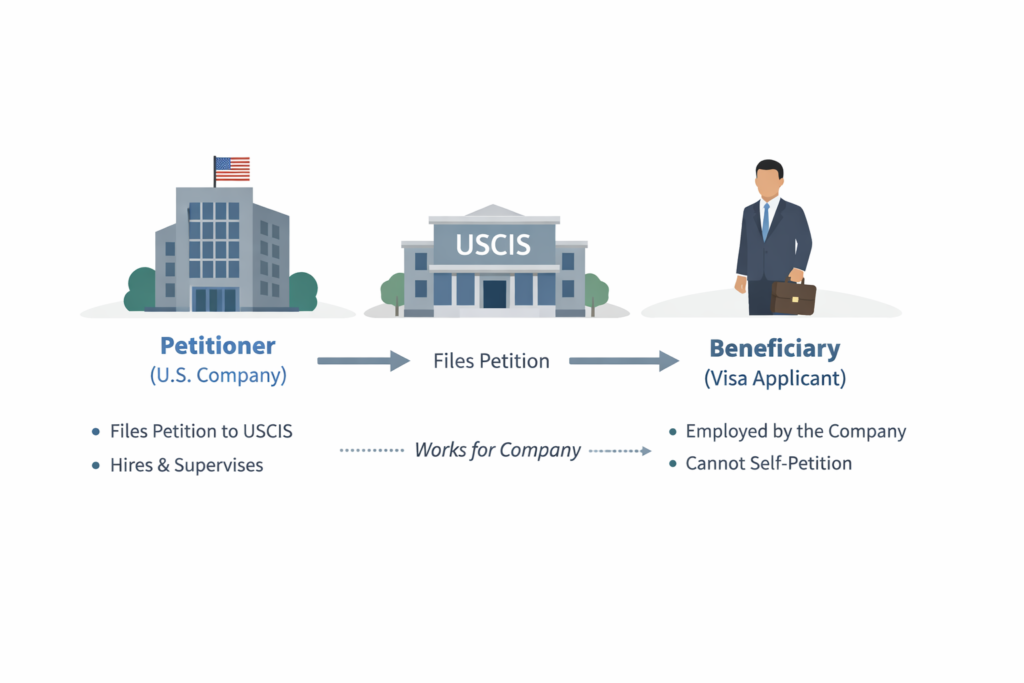
To understand how this works, it helps to distinguish between two roles. The beneficiary is the individual seeking O-1A status. The petitioner is the U.S. company that files the petition and sponsors the employment. Founders cannot petition for themselves as individuals. However, a separate U.S. legal entity owned by the founder, such as a corporation or LLC, may petition on the founder’s behalf, as long as a genuine employer–employee relationship exists.
This setup is often referred to as “self-sponsorship,” but legally it remains sponsored by the company, not by the founder personally.
USCIS Policy Changes Enabling Beneficiary-Owned Entities
Summary of January 8, 2025 policy update
On January 8, 2025, U.S. Citizenship and Immigration Services updated its Policy Manual to explicitly address confusion surrounding the control relationship of beneficiary-owned entities. The update addresses longstanding uncertainty about whether a company owned by the O-1 beneficiary can serve as a valid petitioner and confirms that ownership alone does not preclude sponsorship.
The guidance clarifies that a separate legal entity owned by the beneficiary, including a corporation or LLC, may indeed file an O-1 petition on the beneficiary’s behalf. Notably, the update does not permit individuals to self-petition, nor does it relax the standards governing an employer-employee relationship. Instead, it resolves prior ambiguity by confirming that ownership is not disqualifying de facto.
Importance of employer-employee separation (Neufeld memo, FAM)
Although USCIS clarified that beneficiary-owned entities may petition, it reaffirmed that a genuine employer-employee relationship must still exist. Adjudicators continue to assess this relationship based on whether the petitioner retains real authority over the beneficiary’s employment, beyond assessing ownership alone.
In practice, USCIS examines whether the company has the authority to supervise the beneficiary’s work, evaluate their performance, set or approve compensation, and terminate employment. Furthermore, the beneficiary’s ownership of the company is not inherently problematic. The issue arises when the beneficiary retains unchecked control over all employment decisions. In this case, a genuine employer-employee relationship would not exist.
Founders filing a petition through separate legal entities tied to their businesses must have a genuine employer-employee relationship by demonstrating that meaningful authority rests with someone other than themselves. This is most commonly achieved by demonstrating accountability to a board of directors or an independent director. Without this separation, a beneficiary-owned company risks being viewed as a mere extension of the founder rather than as an actual employer.
Choosing a Business Structure and State
Corporations vs. LLCs for O-1A sponsors
From an immigration perspective, both U.S. corporations and LLCs may serve as petitioners. These two entities differ in how they demonstrate a genuine employer-employee relationship and their meaningful oversight of the beneficiary’s work, as required for O1-A approval.
A C-corporation is a standard U.S. corporate entity. C-corps are legally separate from their owners and are governed through a formally-defined hierarchy of shareholders, board of directors, and executive officers. The governance structure is clear: shareholders own the company without managing day-to-day operations; the board of directors makes major business decisions; and executives manage the company and oversee on-the-ground execution. This clear distinction of ownership and responsibility is consistent with USCIS’s employer-employee relationship requirements, and is strongly preferred by venture capital investors.
A limited liability company is a U.S. business entity that is legally separate from its owners (referred to as “members”). An LLC is governed primarily by an operating agreement rather than a rigid statutory hierarchy, as in C-corps. An LLC can be managed directly by its members or designated managers, unlike a corporation, and allows for significant flexibility in how authority, profit-sharing, and oversight are allocated; the operating agreement determines the ownership and responsibility structure.
This flexibility can be double-edged in the immigration context. If the operating agreement does not clearly establish who controls hiring, firing, supervision, and other key decisions, a USCIS officer might question the authenticity of the employer-employee relationship. Most importantly, the beneficiary must not possess unilateral authority over their own employment; this would be incompatible with a bona fide employer-employee relationship.
Delaware vs. Wyoming vs. other states (costs, investor preferences)
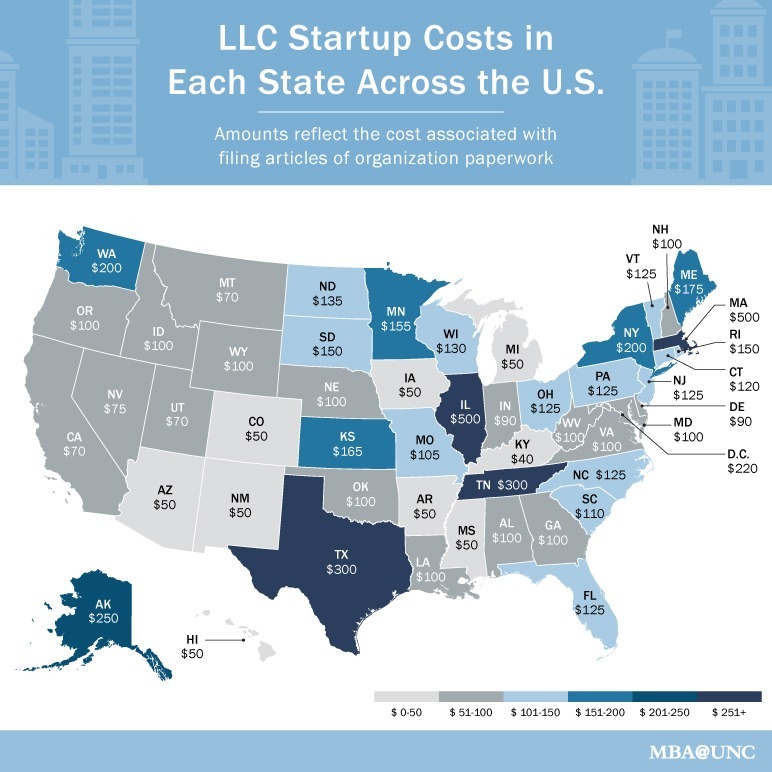
Any U.S. state can establish an LLC or C-corp; from an immigration law standpoint, the choice is immaterial. Delaware and Wyoming are commonly chosen: Delaware offers predictable, investor-friendly governance standards and corporate law, and Wyoming provides low formation costs, minimal ongoing fees, and limited public disclosure of ownership.
Delaware is commonly the default jurisdiction for incorporation, given its well-developed and predictable body of corporate law. Establishing a Delaware C-Corp reinforces the clear separation between ownership to both USCIS officers and investors; demonstrating the independent oversight required for O1-A filing, and the separation of fiduciary duty and execution that most investors expect.
Wyoming is a common choice for establishing LLCs due to its low fees, flexible management structures, and strong owner-privacy protections. For those who prioritize low administrative costs and simplicity, Wyoming is a good choice. As with all LLCs, it is important to carefully draft operational agreements to ensure control is clearly apportioned. Although Wyoming offers cost efficiency and privacy, the founder must exercise caution in clearly demonstrating oversight to satisfy USCIS scrutiny. Although incorporating in Delaware can be more expensive and administratively burdensome than elsewhere, Delaware offers institutional credibility and governance clarity that more easily proves the requisite employer-employee relationship.
Delaware vs. Wyoming: Incorporation Advantages and Disadvantages
| Factor | Delaware | Wyoming |
| Typical use case | Venture-backed startups, high-growth companies | Bootstrapped startups, solo founders, and closely held businesses |
| Entity types most commonly used | C-corporations | LLCs |
| Investor familiarity | Very high: preferred by U.S. venture capital and institutional investors | Low: generally unfamiliar to institutional investors |
| Corporate law framework | Highly developed and predictable, with extensive case law | Simple and flexible, but less developed jurisprudence |
| Specialized business courts | Yes: Delaware Court of Chancery focuses exclusively on business disputes | No: specialized business court |
| Governance clarity | More formal: strong statutory separation between shareholders, directors, and officers | Flexible governance: authority depends heavily on operating agreements |
| Ease of demonstrating employer-employee relationship (O-1A context) | Generally easier due to board-centric structure | Requires careful drafting to clearly establish control and oversight |
| Formation costs | Moderate | Low |
| Ongoing fees and franchise taxes | Higher annual franchise tax obligations (especially for corporations) | Lower due to minimal annual fees and simplified compliance |
| State corporate income tax | Yes | No |
| Owner privacy | Limited: ownership and officers are often publicly visible | Strong: owners can remain largely anonymous |
| Administrative complexity | Higher, especially as companies scale | Lower, simpler ongoing compliance |
| Best suited for founders who… | Plan to raise capital, add investors, and formalize governance early | Want cost efficiency, flexibility, and privacy without outside investors |
In some cases, incorporating in other states may make strategic sense due to state specific tax considerations. What matters most is that the company, not the founder, clearly controls the employment relationship.
Step-by-step incorporation process (Articles of Incorporation/Organization, EIN, registered agent)
USCIS looks at two core issues when reviewing O-1A petitions filed by founder-owned companies. First, whether the company is a real, separate legal entity. Second, whether it can genuinely function as an employer with authority over the founder’s role.
Step 1: Form the legal entity (separate legal identity)
The process starts with forming a U.S. company in your chosen state. For corporations, this means filing a Certificate or Articles of Incorporation. For LLCs, it means filing Articles of Organization. This step establishes that the petitioner is a distinct legal entity and not an informal extension of the founder.
Step 2: Appoint a registered agent (official point of contact)
A registered agent serves as the company’s official recipient for legal and government correspondence. This helps demonstrate that the company is properly set up, reachable, and capable of meeting basic compliance obligations.
Step 3: Obtain an EIN (operational and tax identity)
An Employer Identification Number issued by the IRS confirms that the company can operate as an employer for tax, payroll, and banking purposes. It is another indicator that the business is functional and not purely theoretical.
Step 4: Create immigration-ready governance documents (employer authority)
Governance is the most critical element for O-1A sponsorship. The company’s documents must clearly show who has authority over employment decisions such as supervision, compensation, and termination.
For corporations, this is typically established through bylaws and board resolutions. For LLCs, it is usually done through an operating agreement and written consents. These documents help show that control rests with the company, not solely with the founder.
Step 5: Document basic operational activity (where available)
Finally, it helps to show that the company is operating in practice. This can include basic materials that reflect real business activity, such as a bank account, website, contracts, letters of intent, or a cap table. These materials reinforce that the role offered to the founder is tied to actual business plans.
What to include in your O-1A petition
For O-1A filings, this is typically supported by formation documents, EIN confirmation, governance records (bylaws or operating agreement), board or manager resolutions, and basic materials showing that the company is operating, where available.
Establishing Corporate Governance and Oversight
Employer-employee relationship requirements
Adjudicators look for evidence that an actual employer-employee relationship is genuinely exercised. To prove that governance functions in practice and not merely on paper, establishing a formal hierarchical structure, creating governance documents, and tracking correspondence that demonstrate this employer-employee relationship shows actual oversight.
Setting up a board of directors or independent directors
Most founders satisfy the oversight requirement by appointing at least one independent director. Investors, advisors, or experienced industry professionals commonly serve in this role, so long as they are not financially or personally dependent on the beneficiary.
Crafting bylaws, operating agreements, and board resolutions
Governance documents should clearly demonstrate the board’s or independent directors’ authority over employment decisions, including hiring, compensation, and termination. These provisions are critical for avoiding Requests for Evidence (RFEs) and further delays.
Independent director qualifications and documentation
USCIS may scrutinize whether a director is genuinely independent, prompting an RFE. Supporting documentation typically includes professional backgrounds, signed statements acknowledging authority, and confirmation that no familial relationship exists.
Conducting meetings and maintaining minutes
Regular meetings and detailed minutes-keeping with the board or an independent director demonstrate that the oversight structure is ongoing and genuine.
Drafting O-1A-Compliant Employment Agreements
The employment agreement should clearly reflect what the founder will actually do in the company and how the role fits into the O-1A petition. Job duties, reporting lines, compensation, and termination rights should be easy to understand and consistent across all documents submitted to USCIS.
To show that the company is a real employer and not just an extension of the founder, the agreement should be signed by someone other than the founder acting as the employee. In practice, this is usually an independent director or another authorised company officer.
Founders are often paid through a mix of salary, equity, and bonuses. This is normal, but it needs to be explained clearly. USCIS may look at whether the compensation makes sense for the role and the stage of the company, especially in early stage startups.
O-1A Eligibility: How Extraordinary Ability Is Evaluated
O-1A eligibility is often described as meeting at least three out of eight regulatory criteria, but in practice this is only the starting point. USCIS does not approve cases by simply counting documents or checking boxes. Officers look at the full picture and assess whether the evidence shows sustained recognition, verified impact, and a clear position at the top of the field.
The criteria function as a framework, not a scorecard. What matters most is how the evidence fits together and whether it tells a consistent story of extraordinary ability. For founders, this often means showing how their work has influenced a market, attracted independent validation, or led to outcomes that go beyond routine business success.
Following recent policy clarification, USCIS has also shown more flexibility in how extraordinary ability can be demonstrated in emerging and fast-moving fields. Founders working in areas like AI, SaaS, and digital media may rely on alternative forms of evidence, as long as they clearly show originality, significance, and recognition by others in the field.
For a practical explanation of how USCIS evaluates O-1A evidence, from meeting the criteria to final merits analysis, we explain it in detail here.
Filing the Petition and Timing Considerations
How O-1A petitions are filed, processed, and positioned for future immigration pathways:
| Stage | What Happens | Why It Matters |
| Form I-129 filing | The petitioning company files Form I-129 with the employment agreement, governance documents, an itinerary of services, and evidence of extraordinary ability. | Establishes eligibility and the requisite employer-employee relationship. |
| Initial approval period | O-1A petitions may be approved for up to three years for the initial period of stay. | Provides a longer runway than many nonimmigrant visas, particularly for founders. |
| Extensions | One-year extensions are available if the qualifying work continues. | Allows founders a straightforward way to extend status as the business evolves. |
| Premium processing | USCIS guarantees adjudication within 15 calendar days for an additional fee. | Useful where timing is critical (i.e., expiring status, travel, fundraising milestones). |
| Regular processing | Processing times vary by service center and may take several months. | Lower cost, but less predictable for planning purposes. |
| Future immigrant pathways | Documentation submitted with an O-1A is often relevant to EB-1A or EB-2 NIW petitions. | Maintaining consistent records of documentation can be reused across multiple filings. |
Conclusion and Next Steps
Under current USCIS policy, a properly structured U.S. startup can petition for its founder, as long as governance and oversight are clearly documented.
While this guide explains the framework and practical considerations, each case is highly fact-specific and evaluated individually by USCIS.
At PassRight, we support founders by combining structured document collection with guidance and preparation by the independent, licensed immigration attorneys, who provide all legal advice and representation.
Need help with your case? Schedule a call with our customer care team. They’ll be happy to discuss your needs and connect you with an immigration attorney.