
For years, the H-1B was the standard pathway for tech professionals. However, as we move through 2026, the landscape has shifted. Recent policy updates have introduced significant costs and structural changes to the lottery system, making the H-1B a complex strategic choice.
Recent updates have made the H-1B more expensive and less predictable. Some applicants now face a $100,000 government fee. Starting in 2026, the selection system also favors higher paid roles. For many candidates, especially those earlier in their careers, the odds are now significantly lower.
At the same time, the O-1A visa—often called the “Extraordinary Ability” visa—has gained traction as a more predictable, albeit high-bar, alternative. This guide outlines the 2026 landscape to help you and your legal team evaluate the most viable path.
So which option makes more sense in 2026?
This guide explains both visas in simple terms, including costs, requirements, flexibility, and long term strategy, so you can decide what fits your situation best.
Not sure which visa makes more sense in 2026? Here’s a quick breakdown:
- H-1B → more expensive + lottery risk
- O-1 → no lottery, more flexible
- H-1B → easier to qualify
- O-1 → more predictable, if you qualify
- Early-career → H-1B
- Strong track record → O-1
Quick Answer: Should You Choose H-1B or O-1?
Choose H-1B if:
- you have a job offer from a U.S. employer
- you don’t yet meet O-1 criteria
- you’re okay with lottery risk
Choose O-1 if:
- you have strong achievements (projects, publications, leadership)
- you want to avoid the lottery
- you need flexibility (founder / multiple roles)
Not sure? This guide compares both options in 2026, including costs, eligibility, flexibility, and green card pathways, to help tech professionals, founders, and employers make more informed decisions.
The New U.S. Work-Visa Landscape in 2026
The U.S. immigration system for skilled workers has undergone more change in the last twelve months than in the last decade. There are three main areas of tension to take into account, given the shifting landscape:
- Nontrivial costs: In addition to the standard government filing fees (approximately $2,000 to $7,400 depending on enterprise size), employers must pay the $100,000 proclamation fee at the time of filing, with some exemptions. For many startups, this single payment can exceed the first-year base salary of a U.S. employee, effectively deterring founders with early-stage ventures or lean budgets.
- Restrictive quota system: The FY-2027 H-1B cap season, opening in March 2026, will operate under a wage-weighted selection process, no longer presenting the lottery selection among qualifying workers, as per the old system. This means that roles at Level IV wages will receive four entries in the lottery pool while Level I roles will receive only one; gone are the days when a junior data analyst and a principal AI researcher both carried identical odds of selection. Employers hiring at lower wage tiers will face significantly steeper odds of lottery selection accordingly, pushing them to explore other visa pathways to bring early- and mid-career talent to the U.S.
- Cross-industry demand for flexibility: Regardless of the field, nontraditional work structures are becoming increasingly common. The H-1B’s single-employer model is prohibitive to many modern businesses. Enterprises built on remote teams, startups composed of multiple entities, and professionals who consult across companies all require flexible visa categories to enter the United States.
These tensions, driven by recent changes to the H-1B and broader industry trends, are redirecting hiring companies and tech professionals alike to consider the O-1A as the most viable pathway to working in the U.S.
H-1B in 2026: Rules, Costs, and Lottery Changes
The New $100,000 Payment Requirement
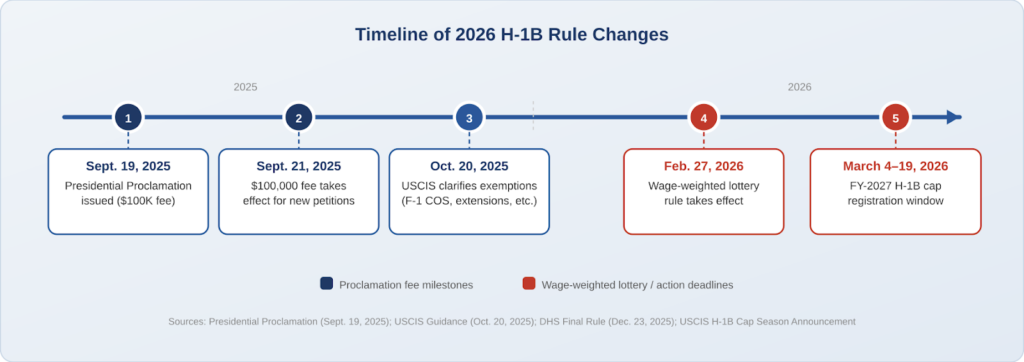
On September 19, 2025, the President issued a proclamation requiring a $100,000 payment as a condition of entry for certain H-1B workers. This applies to petitions filed after September 21, 2025, for beneficiaries outside the U.S. without a valid H-1B status. On October 20, 2025, additional USCIS guidance clarified exemptions from the proclamation payment, narrowing the scope of who actually has to pay the fee. Namely, change-of-status petitions, meaning F-1 students transitioning to H-1B after graduation, are generally exempt; so are extensions, amendments, or transfers for those already in valid H-1B status.
This proclamation payment must be made through “pay.gov” before filing; USCIS will refund the fee if the petition is denied. In some cases, an employer may argue that the petition serves a critical U.S. interest, such as national defense or public health, to avoid the fee; to date, USCIS has granted very few exemptions on this basis. Notably, such a fee does not exist for the O-1A.
Wage-Weighted Selection: Replacing the Random Lottery
As mentioned, USCIS will be selecting H-1B registrations through a wage-weighted system based on the DOL’s four-tier OEWS wage structure, starting with the FY-2027 cap season in March 2026. This is a departure from the “level playing field” of the previous lottery regime, where odds of selection were equal regardless of salary.
Under the new lottery regime, a registration at Level IV receives four entries in the pool; Level III receives three; Level II receives two; and Level I receives one. If a beneficiary has multiple registrations at different wage levels, the lowest OEWS level is assigned. In the case where multiple employers submit registrations for the same beneficiary, that individual is counted only once in the cap. The purpose is to prevent the same beneficiary from occupying spots from applicants and diluting the odds through duplicate entries, a problematic occurrence under the old system.
The new lottery regime purposefully advantages higher-wage workers. DHS projects the selection odds to be roughly 61% for Level IV, 46% for Level III, 31% for Level II, and 15% for Level I workers under the new system. The Penn Wharton Budget Model, a nonpartisan fiscal analysis initiative at the University of Pennsylvania, estimates the new rule will raise the average compensation of selected applicants by about $9,554. For beneficiaries and employers at lower wage tiers, this wage-weighted lottery alone may dissuade applicants from the H-1B. This is also true for startups that compensate with equity rather than high base salaries, which many do: the wage-weighted system produces a structural disadvantage since only cash compensation determines lottery priority, not total compensation. A more cost-effective system, like the O-1A, may be the most viable alternative.
It is worth noting that business groups and immigration advocates have questioned the legality of both the proclamation fee, imposed without Congressional approval, and the wage-weighted lottery, implemented without sufficient procedural justification under the Administrative Procedure Act. As interpretation and actual implementation evolve, employers and candidates should closely monitor developments. Consulting immigration counsel is advisable to ensure that strategy decisions are based on the current regulatory framework and adjudication trends.
Filing Fees, Wage Levels, and Compliance Obligations
H-1B filing costs are significant as is, even without considering the new $100,000 fee. The typical fee breakdown includes:
- Electronic registration fee ($215 per beneficiary)
- I-129 base fee ($780 standard; $460 for small employers)
- Fraud Prevention and Detection Fee ($500)
- ACWIA training fee ($750 for firms with employees of 25 or fewer; $1,500 for more)
- Asylum Program Fee ($600 standard; $300 for small employers).
The total base fee alone is around $2,225 to $3,595, depending on firm size. Additionally, employers with over 50 employees, where more than half hold H-1B or L-1 status, owe a $4,000 surcharge. Premium processing also adds $2,965 as of March 1, 2026. Attorney fees typically range from $2,000 to $5,000. All told, a large employer can expect $7,000 to $11,000 in fees and legal costs. This is before the proclamation fee.
Benefits: Dual Intent, H-4 Work Authorization, Six-Year Duration
Despite the tensions and drawbacks, the H-1B has its advantages. First, it explicitly permits dual intent, allowing holders to pursue permanent residency without jeopardizing their visa status. Second, spouses on H-4 visas may be eligible for employment authorization, significant for families. Next, the initial H-1B term is three years, extendable to six, with further extensions possible while a green card application is pending. This provides enough runway for long-term planning, even if the green card process stalls. Next, H-1B portability allows workers to start at a new employer as soon as the transfer petition is filed, without having to wait for USCIS approval, allowing H-1B holders the flexibility to change jobs with minimal disruption. Last, the qualification bar is attainable for most tech professionals: a bachelor’s degree in a related specialty.
Drawbacks: Cap, Lottery Uncertainty, Job-Specific Sponsorship
First, the annual cap of 85,000 visas (65,000 regular; 20,000 for U.S. advanced-degree holders) has not kept pace with demand. Second, any lottery inherently introduces an inevitable element of uncertainty. Third, the visa is job-specific, so changing employers requires a new petition, and working for multiple employers requires separate petition filings. This introduces a highly restrictive structure for professionals who require flexibility. Last, for those facing green-card processing delays, the six-year cap creates a hard deadline: without a pending green-card application to extend beyond it, workers risk losing authorization entirely.
O-1A Visa in 2026: Extraordinary Ability Visa
Eligibility Criteria and Evidentiary Standards
The O-1A is reserved for individuals possessing extraordinary ability in the sciences, business, education, or athletics, demonstrated through sustained national or international recognition. No formal degree is required.
USCIS evaluates O-1A petitions against 8 evidentiary criteria, of which the applicant must satisfy at least 3, including: nationally or internationally recognized awards; membership in associations requiring outstanding achievement; published material about the applicant in professional or major media; judging others’ work; original contributions of major significance; scholarly articles; employment in a critical capacity at distinguished organizations; and high salary relative to peers.
The “original contributions of major significance” and “published material” criteria tend to be the strongest for tech professionals. Open-source projects with significant adoption, patents, peer-reviewed papers, and press coverage may all qualify. Expert opinion letters provide valuable context about the field of expertise to support adjudications.
Sponsorship Options: Employer, Agent, or Own Company
Unlike the H-1B, the O-1A offers flexible sponsorship. It can be filed by a traditional employer, a U.S.-based agent acting as intermediary, or sometimes as the beneficiary’s own U.S. company.
The agent model suits professionals working across multiple clients. For startup founders, self-sponsorship through one’s own entity is possible where a legitimate operating business, a genuine employer-employee relationship, and a governance structure that exercises independent oversight over the founder’s role are demonstrated.
Flexibility: No Cap, Multiple Employers, Unlimited Extensions
There is no annual cap or lottery associated with the O-1A. Petitions can be filed year-round, and O-1A holders can work for multiple employers simultaneously, provided that each files a petition or is included in the employment itinerary. Extensions are granted in one-year increments with no maximum-stay limit. This is significantly more advantageous than the H-1B’s six-year cap, especially for those facing green-card delays.
Evidentiary Challenges and Legal Complexity
The O-1A’s primary challenge is meeting the evidentiary requirements. Preparing a strong petition typically takes several months, as it involves collecting and structuring substantial supporting documentation.
Based on publicly available information and industry insights, legal fees can vary depending on the complexity of the case and the level of support required. Government filing fees are generally lower than for the H-1B, including the I-129 petition fee ($1,055 standard; $530 for small employers) and optional premium processing at $2,965, as of March 1, 2026.
The real cost of an O-1A is in the time and effort it takes to build a strong petition. A senior engineer with published papers and patents will have a far easier time than a mid-career professional or an applicant whose achievements are not yet well-documented.
Quasi-Dual Intent and Paths to EB-1A or NIW
The O-1A does not explicitly provide dual intent, although in practice, many O-1A holders effectively pursue permanent residency. The main risk is during consular interviews, where officers may question non-immigrant intent.
More strategically, O-1A evidence maps closely onto the EB-1A (extraordinary ability) green-card category, which requires no employer sponsorship, no PERM labor certification, and is not subject to per-country backlogs, as in the EB-2 or EB-3 categories. The O-1A effectively doubles as a green-card evidence-building exercise that is largely advantageous for tech professionals looking to immigrate to the U.S.: expert letters, media coverage, and proof of original contributions assembled for the O-1A can be expanded for both an EB-1A or NIW filing.
Comparing H-1B vs O-1A: Costs, Timelines and Flexibility
| Feature | H-1B | O-1A |
| Eligibility | Bachelor’s degree + specialty occupation | Extraordinary ability (no degree required) |
| Annual Cap / Lottery | 85,000 visas; wage-weighted lottery | No cap; no lottery |
| $100,000 Proclamation Fee | Yes, for new consular-processing petitions | Not applicable |
| Government Filing Fees | ~$2,000–$7,400+ (varies by employer size) | ~$1,055–$1,585 (varies by employer type) |
| Premium Processing | $2,965 eff. March 1, 2026 (15 business days) | $2,965 eff. March 1, 2026 (15 business days) |
| Attorney Fees (typical) | $2,000–$5,000 | $5,000–$15,000 |
| Standard Processing Time | 4–8 months | 7.5–9 months |
| Initial Duration | 3 years | Up to 3 years |
| Maximum Stay | 6 years (extensions with a pending green card) | No maximum; 1-year extensions indefinitely |
| Sponsorship | Employer only | Employer, agent, or own U.S. company |
| Multiple Employers | Separate petition per employer | Yes, via agent or multiple petitions |
| Dual Intent | Yes, explicit | Quasi-dual intent (not explicit) |
| Spouse Work Authorization | H-4 EAD available in certain cases | O-3 dependents generally cannot work |
| Green-Card Pathway | PERM → EB-2/EB-3 | EB-1A or EB-2 NIW (no PERM required) |
Government Fees and $100K Surcharge vs. O-1A Costs
An H-1B petition filed through consular processing will now carry a total employer cost that can exceed $110,000. The same employer filing an O-1A, even with the optional premium processing and experienced attorney fees included, would typically spend between $9,000 to $19,000. The O-1A is drastically less expensive.
Processing Timelines and Predictability
Both visas offer premium processing at $2,965 as of March 1, 2026, but the more meaningful distinction between the two is predictability. H-1B cap-subject petitions can only be filed after lottery selection, with the FY-2027 registration window running March 4 to March 19, 2026, while an O-1A can be filed at any time and offers a more predictable processing timeline.
Self-Sponsorship and Multi-Employer Work
The H-1B requires a clear employer-employee relationship and does not allow founders to sponsor themselves. The O-1A offers more flexibility. It can be filed by a U.S. employer or a U.S.-based agent, which makes it suitable for founders, freelancers, and professionals working with multiple companies. In some cases, a founder’s own U.S. company can act as the petitioner, provided that a proper corporate structure and independent oversight are in place.
Duration, Extensions, and Dependent Status
The H-1B’s six-year maximum generates urgency around the timeline for permanent residency. The O-1A has no equivalent limit, as it allows renewals in one-year increments indefinitely.
The H-1B holds a clear advantage when it comes to dependents: H-4 spouses may qualify for work authorization, while O-3 dependents generally cannot work. For dual-income families, this is often the O-1A’s single biggest drawback.
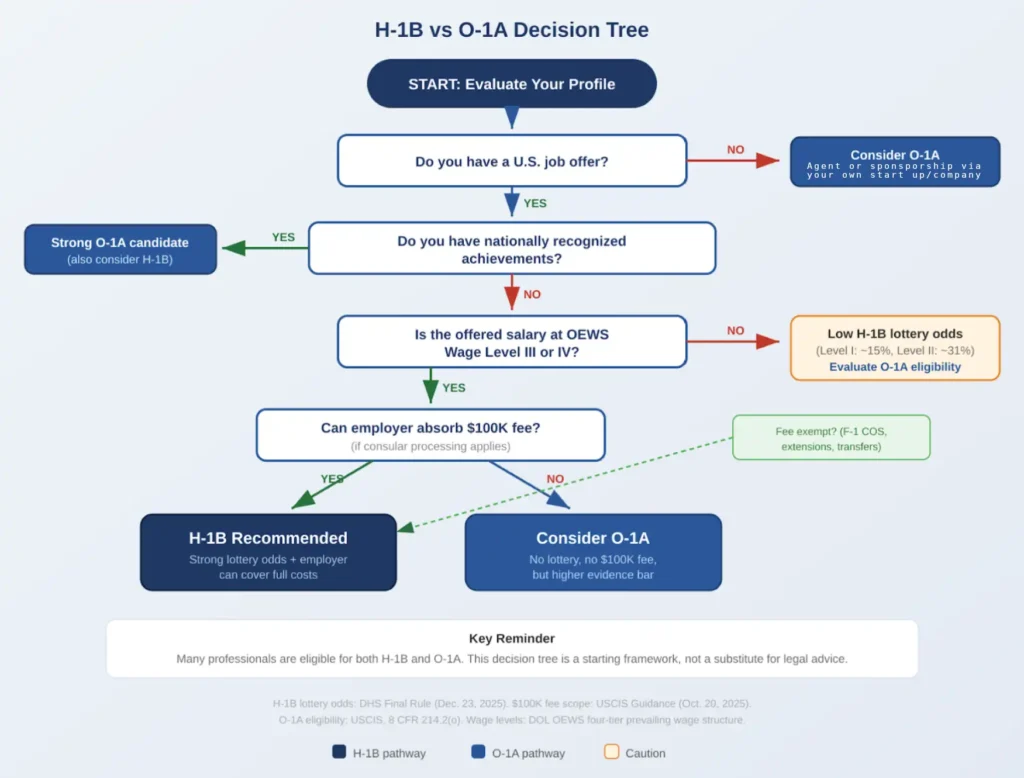
Decision Framework for Tech Professionals and Startups
Individual Profile Assessment
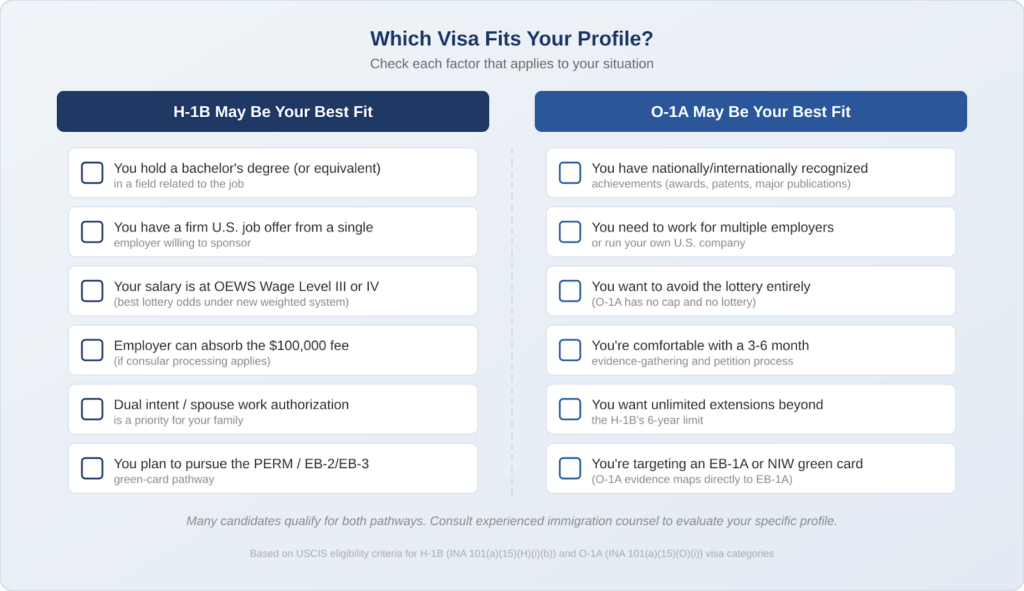
Candidates with a strong public record are generally well-positioned for the O-1A. This includes published research, patents, industry awards, press coverage, and leadership at distinguished organizations. On the other hand, candidates earlier in their careers, with solid academic backgrounds but limited public achievements, may find the H-1B to be the more accessible option.
That said, many tech professionals will underestimate their O-1A eligibility, disregarding open-source contributions, conference talks, peer review for journals, and advisory roles at startups as evidence of extraordinary ability in their fields. For this reason, a consultation with experienced immigration counsel is worth the investment.
Employer Budget and Wage Considerations
An H-1B petition with the $100,000 fee is an order of magnitude more expensive than an O-1A, especially for early-stage or cost-conscious startups. Even without the fee, the wage-weighted lottery means that lower-paying positions face significantly worse selection odds, also presenting a structural problem for startups compensating through equity rather than cash, as expressed. Employers offering Level III or Level IV wages have the best H-1B prospects, while those at Level I or II should weigh whether the O-1A, despite the higher legal costs, offers better return through certainty of outcome.
Risk Tolerance and Flexibility Requirements
The H-1B’s lottery introduces binary risk, which the O-1A eliminates entirely when the petition is strong. The risk of an RFE or denial can be managed through thorough documentation and experienced counsel; lottery risk cannot.
Long-Term Green-Card Strategy
The H-1B’s dual-intent provision and PERM pathway naturally lead to EB-2 or EB-3 green cards. However, per-country backlogs for certain nationals, like Indian or Chinese applicants, can stretch wait times to a decade or more. The O-1A’s alignment with EB-1A offers a virtual shortcut to a green card: there is no PERM required, no employer sponsorship needed, and little backlog concern. The O-1A-to-EB-1A pipeline is one of the most efficient permanent-residency pathways available.
Building a Strong O-1A Case
Mapping Achievements to Evidentiary Criteria
Start by comparing your profile and record of achievements against each of USCIS’s eight criteria. Have you received awards, including industry-specific ones; been featured in publications or podcasts; served as a reviewer or judge; made original technical contributions that peers recognize as significant? Most successful O-1A petitions in tech rely on 3 to 5 criteria, with “original contributions of major significance” and “published material about the applicant” frequently leveraged.
Common Pitfalls and RFE Risks
Insufficient evidence connecting achievements to specific criteria is the most common RFE trigger. Generic recommendation letters, merely passing media mentions, and awards lacking proof of selectivity are frequent fault points. Treating the petition as a career summary rather than a legal argument is another pitfall: each piece of evidence should explicitly support a specific criterion. Filing without adequate preparation risks an RFE, potentially adding months to the timeline.
Transition Strategies: H-1B Visa to O-1A and Beyond
Change of Status Considerations
H-1B holders who have developed strong professional records since their initial filing can apply for and receive O-1A status without leaving the United States. This is an especially effective strategy for H-1B holders approaching the six-year limit, lacking an approved I-140 or a pending green card. This is also an advantageous strategy for professionals seeking greater work flexibility: working for multiple employers, starting a company, or moving into consulting.
Leveraging O-1A Evidence for EB-1A or EB-2 NIW
Notably, the documentation assembled for an O-1A petition is foundational for a future EB-1A or NIW green-card application. The evidentiary criteria align closely across these categories, and much of the same evidence can be reused or updated. The O-1A-to-EB-1A pipeline is increasingly seen as the strategic alternative to the H-1B-to-PERM route, particularly for tech professionals, evading many of its drawbacks and limitations.
In short, the immigration landscape for tech talent in 2026 is more complex than it has been in years. The H-1B remains viable for professionals with strong employer backing and competitive salaries, but rising costs, lottery uncertainty, and structural limitations have highlighted the advantages of the O-1A. Founders, senior engineers, and professionals whose achievements are more impressive than their degrees or credentials have viable options; choosing the right path requires current data and qualified legal guidance.
What About the H-1B in 2026?
H-1B results are being released now. If you weren’t selected, this is the right moment to plan your next step.
Need help with your case? Schedule a call with our customer care team. They’ll be happy to discuss your needs and connect you with an immigration attorney.