


The H-1B has long been the default work visa for companies hiring international talent in the U.S. For tech startups in particular, it was often the first option on the table.
That has changed. Recent regulatory changes have made the H-1B significantly more expensive and harder to plan around. For large corporations, higher costs are a manageable friction point. For early-stage startups, they are a real obstacle.
For most founder scenarios, three categories cover the practical ground: L-1A, O-1A, and E-2. Each fits a different founder profile, requires different evidence, and leads to different long-term outcomes. The rest of this guide covers how they compare.
The Three Main Alternatives for Tech Startup Founders
These three categories cover most startup founder scenarios beyond H-1B. Each one fits a different profile and requires a different type of evidence.
L-1A Visa for Startup Executives
The L-1A is for executives and managers transferring from a foreign company to a U.S. affiliate, subsidiary, or branch. It comes in two forms. If the U.S. entity already exists, the transfer is approved for up to 3 years. If it does not, a “new office” L-1A allows the founder to establish a U.S. entity and lead its operations, with an initial 1-year period. At renewal, USCIS typically looks for evidence that the U.S. operation has grown enough to support a genuine executive role. The foreign company must have been actively operating within the past three years, with the founder in a managerial or executive capacity for at least one continuous year. The maximum stay is 7 years.
The L-1A is most relevant for founders who already run an established company abroad and are expanding into the U.S. market, or who have an existing U.S. entity connected to their foreign operation.
O-1A Visa as a Founder-Driven Strategy
The O-1A is an individual-merit visa for people with extraordinary ability in their field. It focuses on professional track record, achievements, and original contributions. To qualify, applicants must meet at least 3 of 8 evidentiary criteria: awards, published material about their work, high salary relative to peers, membership in selective organizations, judging the work of peers, original contributions of major significance, authorship of scholarly articles, and a leading or critical role in distinguished organizations. For tech founders, venture funding from recognized firms, acceptance into elite accelerators, media coverage in industry publications, patents, and widely adopted products can serve as supporting evidence.
The O-1 visa has no lottery, annual cap, or nationality restriction. It requires a U.S. employer or agent as sponsor. As of January 2025, USCIS confirmed in its updated Policy Manual that a separate legal entity owned by the founder, such as a corporation or LLC, may sponsor the founder for an O-1A visa. Simply owning the company does not prevent it from acting as the petitioner. However, USCIS still expects to see a legitimate employer-employee relationship. In practice, this usually means the company should have governance structures showing independent oversight of the founder (e.g such as a board of directors or an independent director with actual decision-making authority).
The O-1A may be worth considering for founders with a strong professional record, regardless of their company’s stage or place of incorporation.
E-2 Visa and Investment-Based Entry
The E-2 is a treaty investor visa that requires a substantial investment in the U.S. It is available only to nationals of countries that hold a qualifying treaty with the United States. Citizens of India and China, for example, do not qualify. There is no fixed statutory minimum for what counts as “substantial.” While many successful E-2 startup cases involve investments in the tens of thousands of dollars or more, the required amount depends on the nature of the business and the proportionality of the investment. The investment must be committed and at risk. Funds sitting untouched in a bank account do not satisfy the requirement. The business must also be more than marginal, meaning it needs to generate income beyond what merely supports the founder and their family. The E-2 status renews indefinitely in two-year increments. For more detail on how visa validity and authorized stay work in practice, see our E-2 guide.
The E-2 has no built-in path to permanent residency. Founders who want a green card will need to qualify under a separate category, such as EB-1A, EB-2 NIW, or EB-5, while keeping E-2 status active in parallel. This is manageable but requires planning from the start.
The E-2 is most relevant for founders from treaty countries who have capital to commit and want to launch and operate a U.S. business.
Comparative Analysis: L-1A vs O-1A vs E-2
When weighing the L-1A vs. O-1A vs. E-2, the right choice will depend on the founder’s professional profile, nationality, permanent residency goals, and their company’s stage of development.
| Category | L-1A | O-1A | E-2 |
|---|---|---|---|
| Basis | Intracompany transfer of an executive/manager | Extraordinary ability in the field | Substantial investment in a U.S. business |
| Nationality restriction | None | None | Treaty country nationals only |
| Ownership requirement | Qualifying corporate relationship between a foreign & U.S. entity | None: agent or employer sponsor | At least 50% ownership or operational control by treaty country |
| Prior work abroad | 1 year in managerial/executive role within the past 3 years | None | None |
| Investment required | No fixed amount; financial viability needed to support new entity established in the US | None | “Substantial” (~$60K–$100K+ for tech startups) |
| Annual cap/lottery | None | None | None |
| Initial validity | 1 year (for “new office” L-1A); 3 years (for established businesses in the U.S.) | Up to 3 years | Up to 5 years (varies by treaty) |
| Maximum stay | 7 years | Unlimited renewals (1-year increments) | Unlimited renewals (2-year increments) |
| Premium processing | Yes (15 business days) | Yes (15 business days) | Consular: No; Change of Status: Yes |
| Direct green card path | EB-1C (no PERM required) | most standard path – EB-1A (no PERM required) | No direct path; must pursue a separate category like EB-1A |
Visa Eligibility: Who Qualifies for What
Although some founders may qualify for more than one category, the eligibility standards differ significantly, and most founders will not have the profiles to freely select between their preferred options. The choice depends on founder profiles, enterprise maturity, nationality, and other factors.
L-1A requires a real, functioning foreign company and a documented executive or managerial role. A founder who singlehandedly coded a product in a co-working space, without ever having built a team abroad, will likely not qualify for the L-1A. USCIS requires an organizational structure where the founder supervised professional staff or managed a key business function.
O-1A focuses on personal standing. Founders who have raised institutional funding, won industry awards, spoken at major conferences, been featured in recognized press, or hold patents that others have adopted may meet the threshold. USCIS evaluates each criterion with genuine skepticism, so simply being a funded founder is insufficient on its own.
E-2 eligibility depends greatly on two things: nationality and capital. A passport from a non-treaty country is automatically disqualified, regardless of the investment. For eligible nationals, the investment must already be committed or actively in the process of being committed; pledges or promissory notes are insufficient to meet the standard.
A good starting point when exploring the best visa option is an honest self-assessment against these thresholds.
Company Structure & Ownership Requirements
Each visa will impose distinctive requirements for how the startup must be structured.
For L-1A, the U.S. and foreign entities must have a qualifying relationship, such as a parent, subsidiary, branch, or affiliate relationship. The foreign entity must be doing business outside the United States and cannot exist solely as a shell or paper organization.
O-1A imposes no corporate structure requirement tied to the visa itself. The petition may be filed by a U.S. employer, an agent, or a separate legal entity owned by the founder such as the founder’s own corporation or LLC. Using an agent petition provides additional flexibility, allowing the founder to work for their own startup while engaging in other activities approved in the filing. However, this can be questioned by the USCIS if you are a founder. In the eyes of USCIS you come to the US to build something new, not to be a consultant.
E-2 requires the applicant to own at least 50% of the U.S. enterprise, or to show operational control through a managerial position or other governance mechanism. This matters greatly for VC-backed startups: if a funding round dilutes the founder below 50% ownership, maintaining E-2 eligibility may require demonstrating control through voting rights or board composition. Those weighing E-2 vs. O-1A should factor in this ownership dilution.
Speed, Costs, and Renewal Flexibility
Filing speed varies considerably across categories. L-1A and O-1A both offer premium processing (roughly 15 business days for a decision, though this guarantees processing speed, not approval), though O-1A standard processing can take 3–6 months. E-2 is typically filed at a U.S. consulate abroad, where wait times run from 2 to 4 months depending on the location.
Costs also vary greatly. L-1A USCIS filing fees run approximately $1,385 with optional premium processing at $2,965. O-1A fees include a base filing fee plus a mandatory $250 integrity fee introduced in FY 2025. E-2 consular filing fees are lower, around $315, though the “substantial” investment itself is the real cost.
Renewal terms are often overlooked but worth paying attention to. L-1A caps out at seven years total, O-1A can be renewed in one-year increments with no cap, and E-2 renews in two-year increments with no cap, as long as the enterprise is operational. On L-1A, you’re working against a fixed deadline. O-1A and E-2 let you stay in status while you pursue permanent residency, which matters if your green card timeline is uncertain.
Family Members & Dependents
All three visas allow spouses and unmarried children under 21 to accompany the principal applicant.
L-1A dependents get L-2 status. L-2 spouses are employment authorized incident to status, meaning they can work for any U.S. employer without filing for a separate EAD.
O-1A dependents receive O-3 status, allowing dependents to study in the U.S. but not work, posing a real limitation for dual-career families.
E-2 dependents receive E-2 dependent status. E-2 spouses are also employment authorized incident to status and can work for any U.S. employer without filing for a separate EAD.
If spousal work authorization is a priority, L-1A and E-2 have a clear advantage over O-1A.
Green Card Planning Considerations
Often, the question of green card pathways is ultimately the deciding factor between these categories.
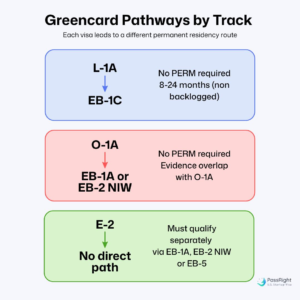
L-1A → EB-1C. The L-1A offers a direct green card route through the EB-1C category, which skips PERM labor certification entirely. As of June 2026, EB-1 priority dates are current for most countries. India and China face significant backlogs, with India currently retrogressed to December 2022. Founders should monitor the Visa Bulletin monthly as cutoff dates can shift. For founders who already have the qualifying corporate relationship in place, this remains one of the faster routes to permanent residency available.
O-1A → EB-1A or EB-2 NIW. O-1A holders are well-positioned for the EB-1A extraordinary ability green card, which also skips PERM, or the EB-2 National Interest Waiver. The evidence assembled for the O-1A overlaps greatly with EB-1A requirements, making for an efficient transition for founders whose businesses and profiles have continued to grow.
E-2 → No direct path. This is perhaps the greatest limitation of the E-2. Founders on E-2 visas who want permanent residency must independently qualify under the EB-1A, EB-2 NIW, or EB-5. This means building a parallel case while keeping E-2 status active.
Common Pitfalls and USCIS Scrutiny Areas
Each category has its own particular weak points that tend to generate Requests for Evidence (RFEs) or outright denials. Knowing these in advance can make the difference between a smooth filing and a stressful back-and-forth.
L-1A pitfalls: The “new office” L-1A draws scrutiny when the U.S. entity appears to be too small or underdeveloped to justify an executive role. USCIS will push back if the beneficiary appears to be doing the day-to-day work themselves, like product development, bookkeeping, or customer support, rather than managing a team. Executive capacity means making decisions with wide latitude and minimal oversight. Managerial capacity means supervising professional staff or managing an essential function at a senior level. A one-person office can be a red flag. The foreign entity also needs to show ongoing, active operations, not just legal existence.
O-1A pitfalls: RFEs often challenge whether the evidence actually demonstrates extraordinary ability. Founders sometimes overestimate the weight of a single criterion. For example, media coverage on a niche blog will not satisfy the “published material in professional or major trade publications” criterion. Every O-1A petition also requires a written advisory opinion from a peer group, labor organization, or recognized expert in the field. A missing or weak opinion is a frequent cause of denial. Evidence must be coordinated across criteria to show sustained recognition, not one-time achievements.
E-2 pitfalls: Adjudicators scrutinize whether investments are genuinely at risk and substantial relative to the business type. Funds in escrow or structured to be easily recoverable raise questions. The marginality test is another common stumbling block: the enterprise needs to show it will generate more than just enough to support the founder and their family, with real potential for job creation or broader economic contribution.
Strategic Decision Framework for Founders
The right visa will depend on the company, beneficiary profile, and timelines.
Which Visa Fits Your Startup?
| Factor | Points Toward L-1A | Points Toward O-1A | Points Toward E-2 |
| You have an operating company abroad | ✅ Strong fit | Neutral | Neutral |
| You held an executive/manager role abroad (1+ year) | ✅ Required | Not required | Not required |
| You have strong personal recognition (awards, press, patents…) | Neutral | ✅ Strong fit | Neutral |
| You are a national of a treaty country | Neutral | Neutral | ✅ Required |
| You have $60K–$100K+ to invest and put “at risk” | Neutral | Neutral | ✅ Required |
| You need a direct green card pathway | ✅ EB-1C | ✅ EB-1A / EB-2 NIW | ❌ No direct path |
| Your spouse needs U.S. work authorization | ✅ L-2 (employment authorized incident to status) | ❌ O-3 (no work) | ✅ E-2 dependent (employment authorized incident to status) |
| Early-stage, pre-revenue startup | More Difficult (must justify executive role) | Possible (if personal merits are strong) | More Difficult (business marginality concerns apply) |
| VC-backed with significant traction | ✅ If foreign operations exist | ✅ Funding strengthens the case | ⚠️ Watch out for ownership dilution |
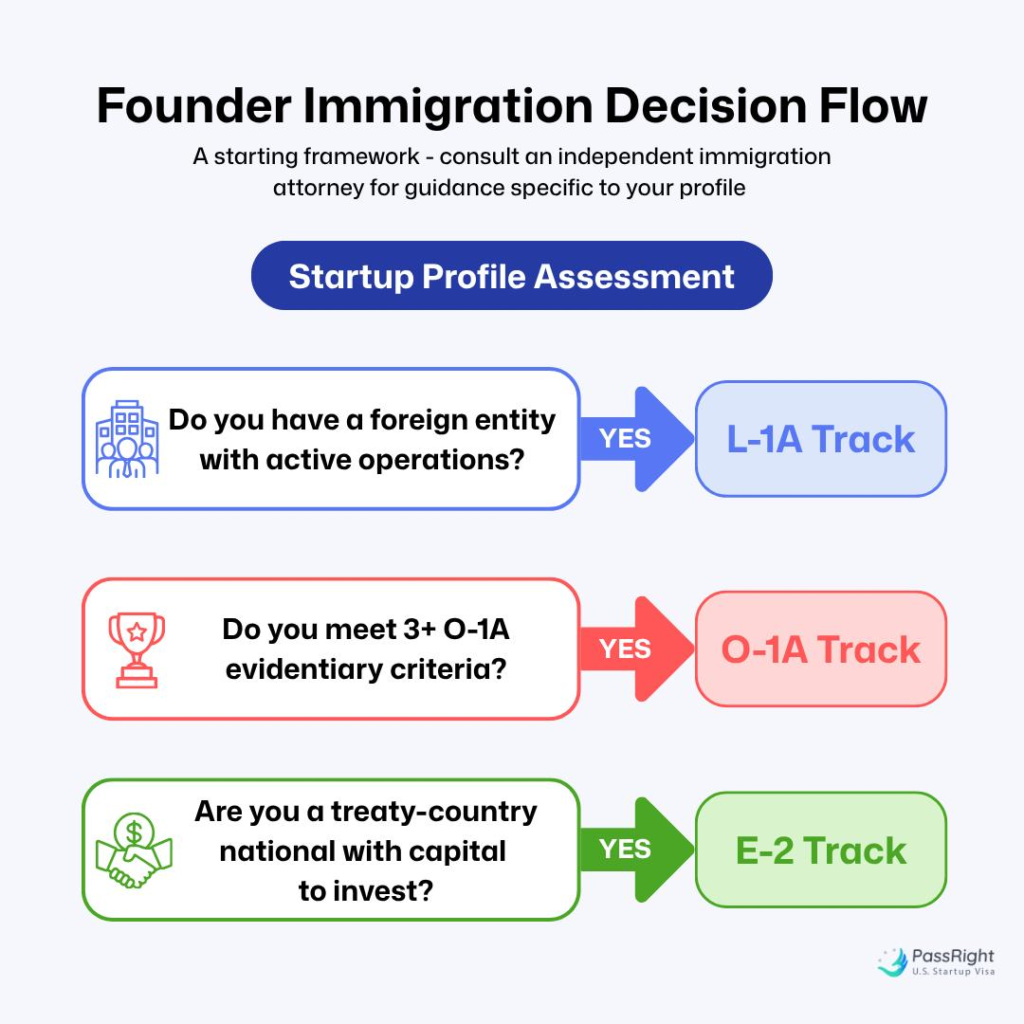
Ilustrative Scenario 1: An established foreign tech company expanding to the U.S…L-1A is likely the strongest fit. The qualifying corporate relationship already exists, and EB-1C provides a clear route to the green card.
Ilustrative Scenario 2: Solo founder with a strong personal track record… O-1A is the natural path. The case rests on individual achievements, compatible with building a startup.
Ilustrative Scenario 3: A treaty-country national with capital, launching a new U.S. venture… E-2 offers quick entry into the U.S. and operational control; plan early for a green card, if desired, through a separate category.
Ilustrative Scenario 4: A founder whose profile suits multiple categories… Consider a dual-track strategy (per the below).
Dual-Track and Transition Strategies
Many of the strongest immigration plans layer strategies combining multiple categories. For example:
O-1A + EB-1A dual-track. The O-1A can bring a founder into the U.S., allowing them to build their business and profile for the EB-1A green card. Since the evidentiary criteria overlap, evidence gathered for the O-1A can be readily expanded for the EB-1A filing. This is one of the most time-efficient paths from temporary status to permanent residency available.
L-1A → EB-1C pipeline. A founder can enter on an L-1A visa, grow their U.S. operation, and file for an EB-1C visa after at least 1 year of operation. The EB-1C is an employment-based green card category for multinational managers and executives; the permanent residency version of the L-1A, essentially. Because the L-1A itself is limited to 7 years, founders should start the EB-1C process early.
E-2 as a bridge. Since E-2 status may be renewed repeatedly as long as the treaty enterprise continues to satisfy E-2 requirements, it can serve as a reliable base while founders accumulate the milestones and evidence needed for an O-1A or EB-1A filing. Some founders launch on E-2, build their U.S. business and personal profile for some years, and then move to O-1A once their profiles are strong.
Switching between categories. It is also generally possible for founders to change from E-2 or L-1A to O-1A (or vice-versa), provided the new category’s requirements are met at the time of filing. A licensed immigration attorney can help evaluate whether a change of status or consular processing makes the most sense.
Conclusion
Choosing the right visa category is only the first step. These petitions routinely run several hundred pages. Every form, support letter, and evidence exhibit needs to tell the same consistent story because a single discrepancy can trigger an RFE or delay everything.
Need help with your case? Schedule a call with our customer care team. They’ll be happy to discuss your needs and connect you with an immigration attorney.


