
Introduction: Why Founders Often Evaluate the EB-1 Path
For founders building companies in the U.S., the difference between EB-1A and EB-1C is not just a legal technicality. It can determine whether your green card survives a pivot, a funding round, or a change in your role. Both paths can work for founders, but they reward very different things. Choosing a path without understanding these nuances can become a significant hurdle in one’s immigration journey.
The EB-1 immigration category is viewed as a decisive path to permanent residence in the U.S. as a first-preference green-card category. On paper, founders may appear to qualify for the EB-1A (Extraordinary Ability), EB-1C (Multinational Executive or Manager), or possibly both.
In 2026, the decision between the EB-1A and EB-1C acquired added nuance, particularly in early planning and evidence-gathering stages. Practitioners observe that modern evidence, like digital publications, podcasts, and open-source leadership, reflects influence and acclaim. Simultaneously, EB-1C adjudications increasingly scrutinize whether a given founder truly functions as an executive (strategy-setting and managing leaders) rather than as an operator. For early-stage startups, this distinction can be difficult to demonstrate without proactive planning and the guidance of independent legal counsel.
This guide explains how EB-1A and EB-1C differ in purpose and evidentiary logic, and why many founders utilize “dual-track planning”, evidence-gathering to build eligibility for both over time.
Understanding EB-1 Categories
The EB-1 category is designed for individuals whose original contributions, leadership, or critical responsibilities place them among the most accomplished in their fields. It is attractive to founders because it avoids PERM labor certification (which can add over 2 years of processing) and generally offers a more predictable path to a green card.
For planning purposes, it is worth noting:
- Both are “first preference” categories, receiving high priority in the employment-based system.
- Both allow derivative beneficiaries (spouse and unmarried children under 21).
From here, each category diverges in what they reward:
- EB-1A rewards founders with extraordinary abilities: sustained acclaim, original contributions, and demonstrated recognition by others in the field.
- EB-1C focuses on the executive or managerial role in a multinational structure: specifically, executive/managerial authority abroad and in the U.S.
EB-1 I-140 Approval Trends
While approval volume does not determine which path is better for an individual, data shows that both EB-1A and EB-1C remain actively used strategies. Independent legal analysts note that while EB-1A is flexible, it often faces higher scrutiny during “Final Merits” determinations compared to the more objective corporate documentation used in EB-1C.
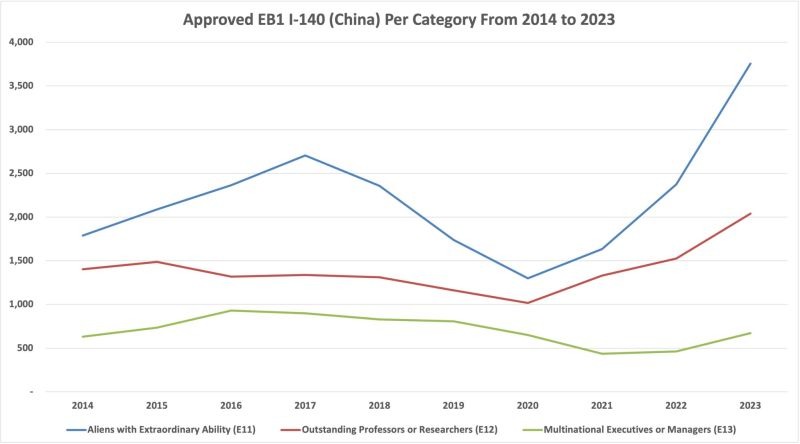
Source: USCIS, Form I-140 Performance Data (FY2014–FY2023).
EB-1A Explained: Extraordinary Ability, Self-Petitioning, and Criteria
EB-1A is a flexible category because it allows founders to self-petition: no permanent job offer is required, and the petition is tied to the individual founder rather than the company.
Ultimately, the EB-1A requires proof of sustained national or international acclaim. Beneficiaries typically meet at least three of the ten regulatory criteria. In 2026, adjudicators look beyond just the criteria to see if the overall profile demonstrates that the applicant is among the small percentage at the very top of their field.
How Founders meet the EB-1A criteria:
The challenge for founders is rarely finding evidence; it is organizing evidence so that it signals independent recognition.
- Original Contributions: Best demonstrated when independent users cite, license, or publicly recognize your work (e.g., patented tech or novel methodologies).
- Published Material: Independent reporting and third-party interviews are generally more persuasive than press releases.
- Judging the Work of Others: Serving on accelerator selection panels or judging pitch competitions often arises naturally and should be documented as it occurs.
- Leading or Critical Roles: The key is proving the criticality of your position to the organization’s success, supported by objective indicators like funding or market position.
- High Remuneration: A strong indicator when benchmarked against industry norms, though often requiring third-party data to support atypical founder compensation.
Digital Achievements in 2026
Legal experts note that USCIS has shifted toward crediting digital evidence, podcasts, video interviews, and open-source leadership when the evidence demonstrates reach, selectivity, and independent recognition.
EB-1C Explained: The Multinational Executive Pathway
EB-1C is designed for executives who oversee individuals, operations, or policies instead of hands-on execution. Unlike EB-1A, the U.S. entity must file the petition on the founder’s behalf.
Founders typically document the following for EB-1C:
- Employment outside the U.S. for at least one year within the last three, in a managerial/executive capacity.
- Future work in the U.S. in a similar managerial or executive capacity.
- A qualifying corporate relationship (parent, subsidiary, or affiliate) between the U.S. and foreign entities.
- An actively operating U.S. business capable of supporting the role.
Duty-mapping: What Adjudicators Look At
The success of an EB-1C petition hinges on strategic leadership and delegation. Strong EB-1C cases often include:
- A clear breakdown of duties by percentage of time.
- Evidence of strategic decision-making (not task execution).
- Proof of delegation to managers or professional employees.
- Organizational charts showing layered management.
EB-1C Dependency Risk
The primary disadvantage of EB-1C is founder dependency on the petitioning company. As an employer-sponsored visa, material changes to the company can jeopardize the process. Because of this risk, many founders work with independent attorneys to build EB-1A-quality evidence in parallel as a safeguard.
Key Differences Summary
| Dimension | EB-1A (Extraordinary Ability) | EB-1C (Multinational Executive) |
| Focus | Personal achievements | Executive/managerial role |
| Petition type | Self-petitioned | Employer-sponsored |
| Flexibility | High | Moderate |
| Dependency risk | Low | High (tied to company) |
| 2026 Premium | 15-Calendar-Day response | 45-Business-Day response |
Not sure which path fits your profile? The answer depends on your evidence, your company structure, and where you are in your founder journey. You can use PassRight to organize your records and connect with independent immigration attorneys to map out your strongest option.
Dual-Track Planning: Options Without Overcommitting
“Dual-track planning” is not necessarily filing both at once, but structuring evidence so that either route remains viable. Independent counsel often suggest this approach since most founder activities support both: recognition supports EB-1A, while organizational growth supports EB-1C.
A Dual-Track Checklist for Founders:
- Step 1: Save evidence of media mentions, awards, and metrics as they happen.
- Step 2: Track invitations to speak or judge and maintain records of open-source impact.
- Step 3: Document hiring milestones and delegations to support an EB-1C “managerial” narrative.
- Step 4: Maintain organizational charts and intercompany agreements in both jurisdictions.
- Step 5: Regularly evaluate which track is more resilient with a licensed attorney before filing.
Conclusion: Planning Your EB-1 Strategy With Intention
Most founders wait too long to think about this. The good news is that EB-1A and EB-1C are not competing choices; they are complementary frameworks. By documenting your achievements and executive role now, you stay prepared.
The next step is to consult an experienced immigration attorney to determine which EB-1 path or dual-track strategy best aligns with your unique evidence and long-term plans.
Need help with your case? Schedule a call with our customer care team. They’ll be happy to discuss your needs and connect you with an immigration attorney.