
For many O-1A holders, approval brings huge relief. After months of gathering evidence, preparing the petition, and waiting for a decision, it is natural to feel that the hardest part is over. While that is partly true, approval is also the beginning of a new phase.
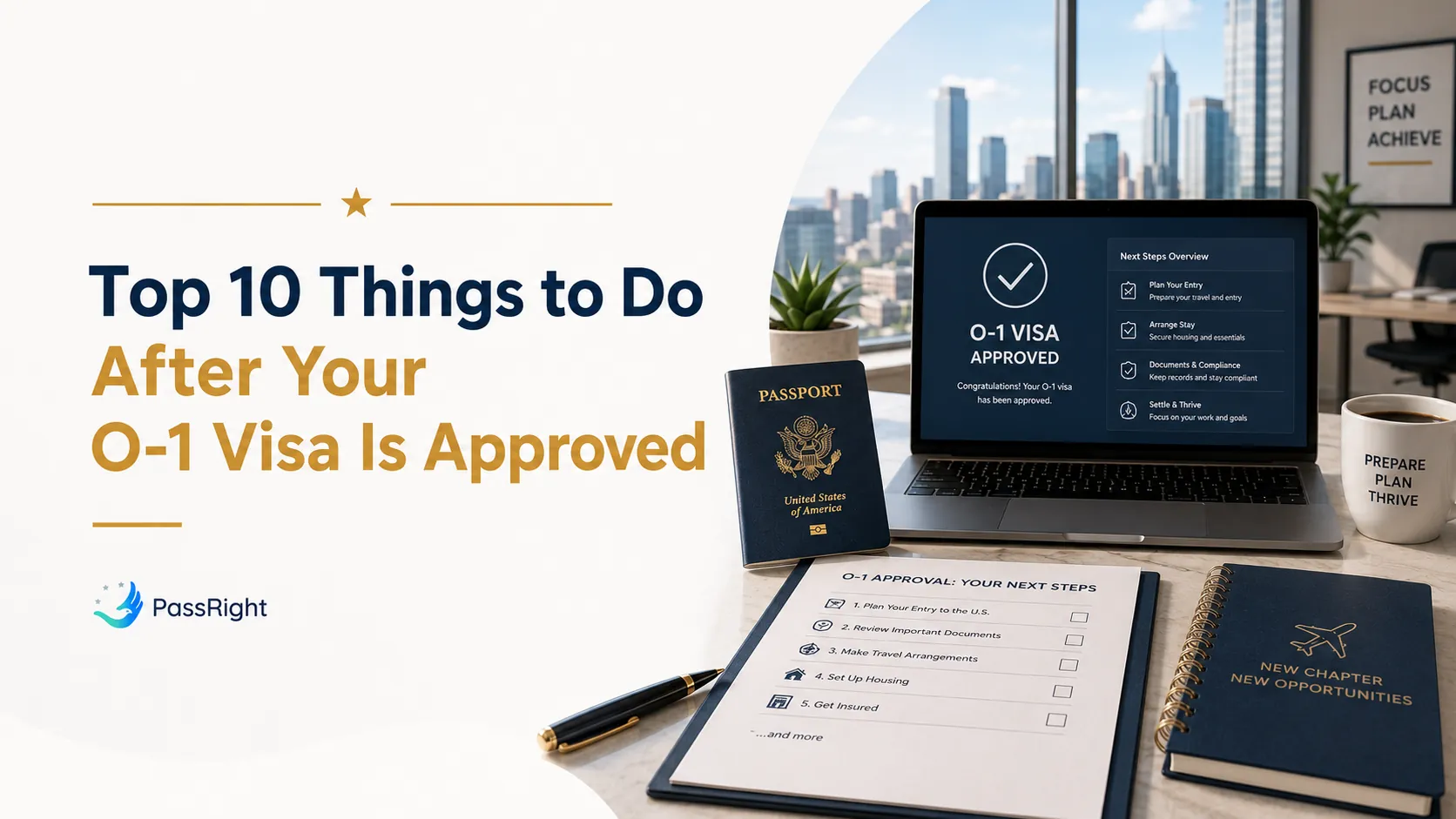
In this guide, we walk through the ten most important things to do after O-1A approval and explain why each of them matters.
Save every approval and status document
Before anything else, organize and preserve every document connected to your case.
The core set includes your Form I-797 approval notice, your O-1A visa stamp in your passport, and any supporting documents your attorney filed on your behalf. If dependents (O-3 holders) were included in the petition, keep their approval records alongside yours.
Store at least two copies: one physical and one digital, backed up to a location you can access from anywhere. These documents will be requested repeatedly by employers, banks, landlords, government agencies, and eventually by USCIS if you file for an extension or a green card. Losing or misplacing them creates delays that are entirely avoidable.
A clean post-approval file should contain, at minimum:
- the I-797 approval notice,
- the visa stamp page (photographed clearly),
- the original petition scan submitted to USCIS
- any RFE responses filed during adjudication & responses sent to USCIS
- and, once you have entered the U.S., your I-94 record.
Check your visa stamp, approval notice, and admission details
Two documents govern your status, and they are not the same thing.
- The I-797 approval notice confirms that USCIS approved the O-1 petition filed on behalf of the O-1A beneficiary. It specifies the validity period of the approved petition, the classification (O-1A), and the petitioner on record.
- The visa stamp in your passport is issued by a U.S. consulate and governs your ability to enter the United States. It has its own validity dates, which may differ from the I-797 period.
When you enter the U.S. at a port of entry, a Customs and Border Protection officer determines your period of admission – the actual duration of authorized stay in the U.S. This period is recorded on your I-94 and is what controls how long you may legally remain in the country. It may be shorter than the dates on either the I-797 or the visa stamp.
Read all documents carefully and confirm the dates are consistent with what you expected. If anything looks incorrect, flag it with your attorney before assuming it is fine.
Download and verify your I-94 after entering the U.S.
The I-94 Arrival/Departure Record is one of the most important documents for any nonimmigrant visa holder, and it is commonly overlooked.
We regularly see this step overlooked after arrival in the United States. Many visa holders assume their admission record automatically reflects the correct status and dates, only to discover an issue months later when applying for an extension, changing status, or completing employment paperwork.
For most travelers entering by air or sea, the I-94 is now issued electronically. You will not receive a paper copy at the border. To access it, visit the CBP I-94 website at i94.cbp.dhs.gov and retrieve your record using your passport details.
When you download your I-94, verify the following: your name is spelled correctly, the class of admission reads O-1, the admit-until date matches the authorized period of stay you were told to expect, and there are no errors in your date of birth or passport number.
Errors on the I-94 are not uncommon, and they are the traveler’s responsibility to identify and correct. If the I-94 reflects incorrect information, the correction process involves contacting CBP – a step that is significantly easier to take shortly after entry than months later when a problem surfaces at a bank or during an extension filing.
Download and save a printed or PDF copy of your I-94 immediately after entry, and again after any future trips abroad.
Report address changes when required
O-1A holders are subject to U.S. immigration address reporting requirements. Under federal immigration law, most noncitizens are required to notify USCIS of a change of address within ten days of moving.
The reporting is done through Form AR-11, which can be filed online at https://www.uscis.gov/addresschange. The process is straightforward and takes only a few minutes, but it is a legal obligation that is often overlooked during the logistical chaos of relocating.
Keep in mind that this requirement applies each time you move, not only when you first arrive. If you change apartments, relocate to a different city, or move to a new state, a new AR-11 filing is required within ten days.
Address changes may also need to be reported separately to your employer and, in some cases, to USCIS in connection with a pending petition or application. If you have an open case with USCIS – such as a pending extension – confirm the correct reporting procedure with your attorney.
Apply for or confirm your Social Security Number
Without an SSN, many everyday tasks become more complicated than people expect. An SSN is required for employment, tax filing, and many other administrative steps. It is also commonly requested by banks, credit bureaus, and landlords.
O-1A holders are typically eligible to apply for an SSN through the Social Security Administration (SSA). You need to visit an SSA office in person with your passport, visa, I-94, and I-797 approval notice. Wait times vary by location.
You may need to wait at least ten days after entering the U.S. before applying to allow your immigration records to update in the SSA’s system. If you apply too early, the SSA may be unable to verify your status.
In practice, we often see the Social Security application pushed down the priority list during relocation. Unfortunately, delays with the SSN tend to create a domino effect, making everything from payroll setup to banking and housing more complicated. Visit ssa.gov for current requirements before visiting an office, as documentation requirements may vary.
For a detailed step-by-step guide, see our article: Social Security application after visa approval
Open a U.S. bank account
A U.S. bank account is one of the first things most O-1A holders set up after arriving in the United States. You need it to receive payroll, pay rent, set up utilities, and manage daily expenses. Without one, you are dependent on workarounds that create unnecessary friction.
Most major U.S. banks offer accounts to nonimmigrant visa holders, although documentation requirements may vary by institution. Typical requirements include a valid passport, visa, I-94, proof of U.S. address, and sometimes the I-797 approval notice. Requirements vary by institution, so it is worth calling ahead or checking the bank’s website before visiting a branch.
Some banks are more familiar with nonimmigrant visa holders than others. If you encounter repeated difficulty, community banks and credit unions sometimes have more flexible onboarding processes for individuals without established U.S. credit histories.
Opening an account is not a legal obligation, but it is a practical one. Doing it in the first two weeks removes a significant logistical obstacle from everything that follows.
Set up health insurance
Health insurance is an important part of settling into life in the United States.
If your employer offers group health insurance, enrollment is typically handled during onboarding. Pay attention to enrollment windows, as missing the initial period may mean waiting until the next open enrollment period unless you qualify for a special enrollment event.
If your employer does not offer coverage, or if you are self-employed or operating through your own entity, you will need to purchase coverage independently. The Health Insurance Marketplace at healthcare.gov is one option. Private plans purchased directly from insurers are another.
Health insurance costs, deductibles, and network coverage vary significantly. Before selecting a plan, confirm that providers and facilities you expect to use are included in the network.
This is an area where individual circumstances – income, employment structure, state of residence, and family situation – affect the right answer considerably. The only consistent recommendation is to not leave this unresolved.
Understand your U.S. tax situation
U.S. tax obligations for nonimmigrant visa holders depend on residency status for tax purposes, which is a separate concept from immigration status.
The IRS uses the Substantial Presence Test to determine whether a nonimmigrant visa holder is considered a U.S. tax resident for a given year. If you meet the test, you are generally taxed on worldwide income, similar to a U.S. citizen. If you do not meet the test, you are typically taxed only on U.S.-source income. The full rules and thresholds are available at irs.gov.
Separately, if you are employed by a U.S. company, federal and state income taxes, as well as Social Security and Medicare contributions, will likely be withheld from your paycheck. If you are self-employed or compensated through a business entity, estimated quarterly tax payments may apply.
State tax obligations vary and depend on where you live and work. Some states have no income tax; others have significant tax regimes. Relocation between states during the tax year can create multi-state filing obligations.
For many newly arrived O-1A holders, the first U.S. tax year is more complicated than expected. Questions about tax residency, foreign income, and state tax obligations come up frequently, especially for founders, consultants, and individuals with international income streams. Engaging a U.S. accountant or tax advisor who has experience with nonimmigrant visa holders is generally worthwhile, particularly in the first year when the rules are unfamiliar and mistakes are easiest to make.
Get housing, driver’s license, and daily-life essentials in order
Settling into daily life in the U.S. involves a set of practical steps that are not immigration-specific but are time-sensitive and interconnected.
Housing. Securing stable housing is a prerequisite for almost everything else. Many landlords require a Social Security number, U.S. credit history, proof of employment, and several months of bank statements. For recent arrivals without a U.S. credit history, some landlords will accept alternative documentation, for example: an offer letter, a larger security deposit, or a co-signer. Extended-stay hotels and furnished short-term rentals are common interim solutions while a permanent lease is arranged. Read our guide to renting an apartment in the USA.
Driver’s license. Requirements for obtaining a state driver’s license vary significantly. Most states require proof of identity, proof of legal presence (such as your I-94 and I-797), proof of state residency, and passing a written and practical test. Some states issue licenses tied to the validity of the visa or I-94. Check your state’s DMV website for current requirements and wait times, as appointment availability varies by location.
Credit history. One surprise for many new arrivals is that an excellent credit history in another country does not automatically transfer to the United States. Building a U.S. credit history from scratch takes time. Secured credit cards and credit-builder products designed for new arrivals are practical starting points. Establishing credit early matters because it affects future lease approvals, loan applications, and in some cases, employer background checks.
Daily logistics. Once you have your SSN and bank account, setting up internet, utilities, and a cell phone plan is usually pretty straightforward. Focus on what you need first and build from there.
Start preserving evidence for a future EB-1A or green card strategy
The O-1A is a temporary nonimmigrant visa. If you are considering permanent residence in the United States, the time to start building toward it is now, not when the visa is about to expire.
The EB-1A green card requires extraordinary ability and sustained national or international acclaim, largely the same evidentiary standard as the O-1A. In many cases, the evidence built for the O-1A forms the starting point for an EB-1A petition. The difference is that the EB-1A standard is typically applied more rigorously, and the documentation must be more extensive.
What this means practically is that the habits formed now, such as saving award notifications, archiving media coverage, keeping records of judging roles, tracking citations and publications, and documenting recognition nationally or internationally, directly support a future green card case. Evidence that is preserved contemporaneously is almost always stronger than evidence reconstructed from memory or incomplete files months later.
One of the most common patterns we see in green card consultations is that applicants underestimate how difficult it can be to reconstruct evidence months or years later. Keeping organized records from the start usually makes future filings significantly easier.
The EB-2 NIW (National Interest Waiver) is the path that most often comes up alongside EB-1A. It operates under a different standard; it requires an advanced degree or exceptional ability, and evidence that your work serves a U.S. national interest, but it does not require the sustained public recognition that EB-1A typically demands. For O-1A holders with strong award and recognition evidence, EB-1A is often considered a natural option. For those whose profile is built more around impact than visibility, NIW may also be worth exploring. An immigration attorney can advise on which path fits your evidence and timeline.
If EB-1A may be your next step, start preserving evidence now.
What are common mistakes after O-1A approval
Based on our experience working with O-1A professionals, founders, researchers, and executives, several post-approval mistakes appear repeatedly.
The most common is assuming that approval means compliance is handled. It is not. Immigration status requires ongoing maintenance – address reporting, timely extension filings, and careful tracking of the authorized period of stay. Missing these steps can create serious problems even for holders who have done nothing intentionally wrong.
A closely related mistake is failing to check the I-94. Many holders assume the I-94 will automatically reflect what they expected. It does not always. An error on the I-94 that goes undetected can complicate extensions, travel, and background checks significantly.
Delaying the Social Security number application is another common problem. The SSN is required for so many downstream steps – tax filing, banking, credit applications – that postponing it creates a compounding backlog of tasks that could have been resolved in the first two weeks.
Finally, failing to document professional activity during the O-1A period is a mistake that only becomes visible later. If a green card petition is eventually filed, USCIS will want evidence of sustained acclaim during the entire period covered by the petition. A gap in documentation is harder to explain than a gap that was never created.
90-day post-approval checklist
| Task | Timing | Why it matters | Source | |
| 1 | Save I-797, visa stamp, and petition documents | Immediately | Required for all subsequent steps | USCIS |
| 2 | Download and verify I-94 | Within 7 days of entry | Confirms authorized period of stay | cbp.dhs.gov |
| 3 | File AR-11 address report | Within 10 days of any move | Federal legal obligation | uscis.gov/ar-11 |
| 4 | Apply for Social Security number | After 10 days from entry | Required for employment and taxes | ssa.gov |
| 5 | Open U.S. bank account | Within first 30 days | Required for payroll and daily expenses | fdic.gov |
| 6 | Enroll in or purchase health insurance | Per employer window or immediately | No automatic U.S. coverage for visa holders | healthcare.gov |
| 7 | Engage a U.S. tax advisor | Within first 30 days | Residency classification and filing obligations vary | irs.gov |
| 8 | Secure housing and state driver’s license | Within first 30 days | Prerequisites for credit, employment, and daily life | State DMV |
| 9 | Begin building U.S. credit history | Within first 60 days | Affects leases, loans, and background checks | consumerfinance.gov/consumer-tools/credit-reports-and-scores ; experian.com |
| 10 | Start a post-approval evidence folder | Ongoing from day one | Supports future EB-1A or other green card filing | USCIS.gov(EB-1A evidentiary criteria) |
In Closing
The people who navigate the transition most smoothly are usually not the ones who move fastest, but the ones who establish good administrative habits early.
Approval is not arrival. The steps that follow approval are what determine whether the visa actually functions the way it is supposed to.
Need help with your case? Schedule a call with our customer care team. They’ll be happy to discuss your needs and connect you with an immigration attorney.